
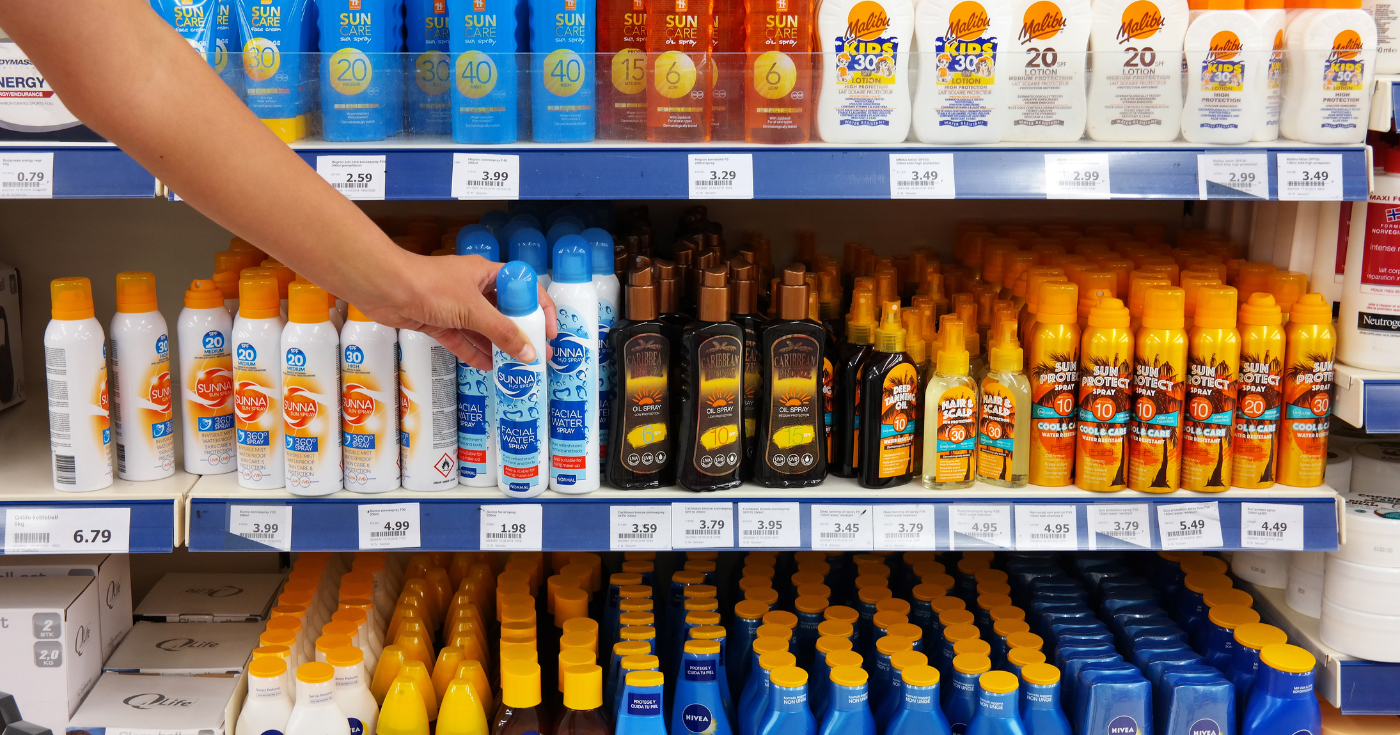
You might think that your sunscreen just depends on where you are. City or beach, same fight? Not so simple. Behind these similar bottles, the differences are more subtle than one might imagine.
And yet, what you apply every morning could well play a much more important role than your days at the sea. Because the real danger does not necessarily hide where you expect it.
City vs. beach sunscreen, formulas designed for opposite uses
Behind the words “daily” or “beach”, it is not just a marketing argument. The products are designed to meet very different uses.
As an expert explains: “A daily urban SPF treatment is formulated to fit into a routine, it has a fluid texture, it is compatible with makeup and it is often enriched with active care ingredients.”
Conversely, sunscreen intended for the beach aims for maximum resistance. “An SPF beach treatment is formulated for maximum performance in certain conditions with resistance to water, perspiration, friction, prolonged and intense UV exposure. Hold is a priority.”
These objectives directly influence the composition: textures, filters, film-forming agents… everything is designed to hold, or on the contrary, to be forgotten on the skin.
But be careful, some mentions are more marketing related. The term “urban protection” can sometimes be nothing more than “pure marketing repositioning”.
The SPF doesn’t change, but your exposure does
This is where many go wrong. It doesn’t matter whether you’re on the terrace or on a beach towel, the protection factor remains the same.
“SPF does not change depending on the environment. SPF50 in the city protects as much as SPF50 at the beach, all things being equal. What changes is the duration and intensity of exposure, not the chemistry of the filter.”
The real difference lies in the hold of the product. Beach sunscreens use specific agents which “create a film that clings to the skin”.
Result: textures often thicker, less discreet. “A water-resistant product is formulated to last in extreme conditions, not to disappear under foundation in the morning.”
Conversely, light everyday textures do not mean less protection. “The light texture is not in itself a compromise on protection. If SPF50 is measured correctly, it is real. A product that is pleasant to apply also encourages you to use more, which works in favor of real protection.”
Exposure in the city, this invisible trap that you underestimate
This is undoubtedly the most underestimated point. In the city, you don’t feel the heat of the sun like at the beach. However, the UV is there.
“We often associate the sun with the beach, with vacations, with the feeling of warmth. In the city, we don’t feel “in the sun”. However, 20 minutes of travel in the morning, a terrace at lunchtime, 20 minutes in the evening, it adds up. Every day. 365 days a year.”
This daily accumulation has real consequences. From a UV index of 3, risks for the skin exist.
“A pigment stain does not form overnight. It is the visible result of years of stimulation of melanocytes by UV, often UVA which passes through clouds and windows discreetly. When the stain appears, the damage has started years before.”
Same observation for more serious pathologies: “It’s not a summer in Ibiza at 20 that explains everything. It’s the daily commute, the weekly terrace, the office window, accumulated over decades.”
1. Can you use beach sunscreen every day in the city?
Yes, but it’s not always pleasant. Beach formulas are thicker, designed to resist water and sweat. Result: they may be less comfortable under makeup or in everyday life.
2. Does an “urban” sunscreen protect less than a beach cream?
No. If the SPF rating is the same, the UV protection is the same. The difference mainly comes down to the durability of the product, not its initial effectiveness.
3. Why are beach sunscreens thicker?
Because they contain film-forming agents which allow the product to adhere to the skin despite water, sweat or friction. This is what guarantees their resistance in intense conditions.
4. Is sun protection really necessary in the city?
Yes, because the exposure accumulates without you realizing it. Travel, breaks on a terrace or even light through windows contribute to progressive damage to the skin.
