
There are those mornings when your lengths dry out and swell, the curls fall apart, everything becomes fuzzy and frizzy. No matter how much you change your mask, the result remains the same: a halo of hair that is difficult to tame. What if this “volume” was not a gift of nature, but the consequence of gestures repeated without thinking about it?
Especially in winter, the cold, the wind and the friction of scarves weaken the fiber: the scales rise, the cuticles become irregular and the hair begins to break and frizz. In other words, they become dry, porous and foamy. Three everyday mistakes maintain this vicious circle, while by correcting them we can really change the texture to the touch.
Mistake #1: Washing your dry hair as if it were very oily
When trying to tame frothy hair, the reflex is often to wash it often, with lots of shampoo and very hot water. This trio loosens the cuticles, removes the protective hydrolipidic film and accentuates porosity. Hair already sensitized by coloring or highlights, such as lightened or gray hair, reacts even more strongly; It is for them that specialized brands recommend sulfate-free products, which are gentler on the fiber.
The choice of shampoo is as important as the frequency. According to the magazine, it is better to avoid in the INCI list:
- Alcohol denat, which dries, to be distinguished from emollient fatty alcohols (behenyl alcohol, cetyl alcohol, stearyl alcohol, cetearyl alcohol);
- aggressive sulfated surfactants such as sodium laureth sulfate (SLES) and sodium lauryl sulfate (SLS);
- mineral oils such as Paraffinum liquidum, mineral oil, Cera microcrystallina, ozokerite, which can dull the lengths.
Mistake #2: Drying and brushing too vigorously
Another almost automatic gesture: get out of the shower, twist your hair in a cotton towel and rub vigorously. Combined with the friction of hats and scarves, these mechanical movements further lift the scales already weakened by the cold. As a result, the fiber swells, humidity from the air penetrates easily and the hair takes on this sparkling appearance, without shine.
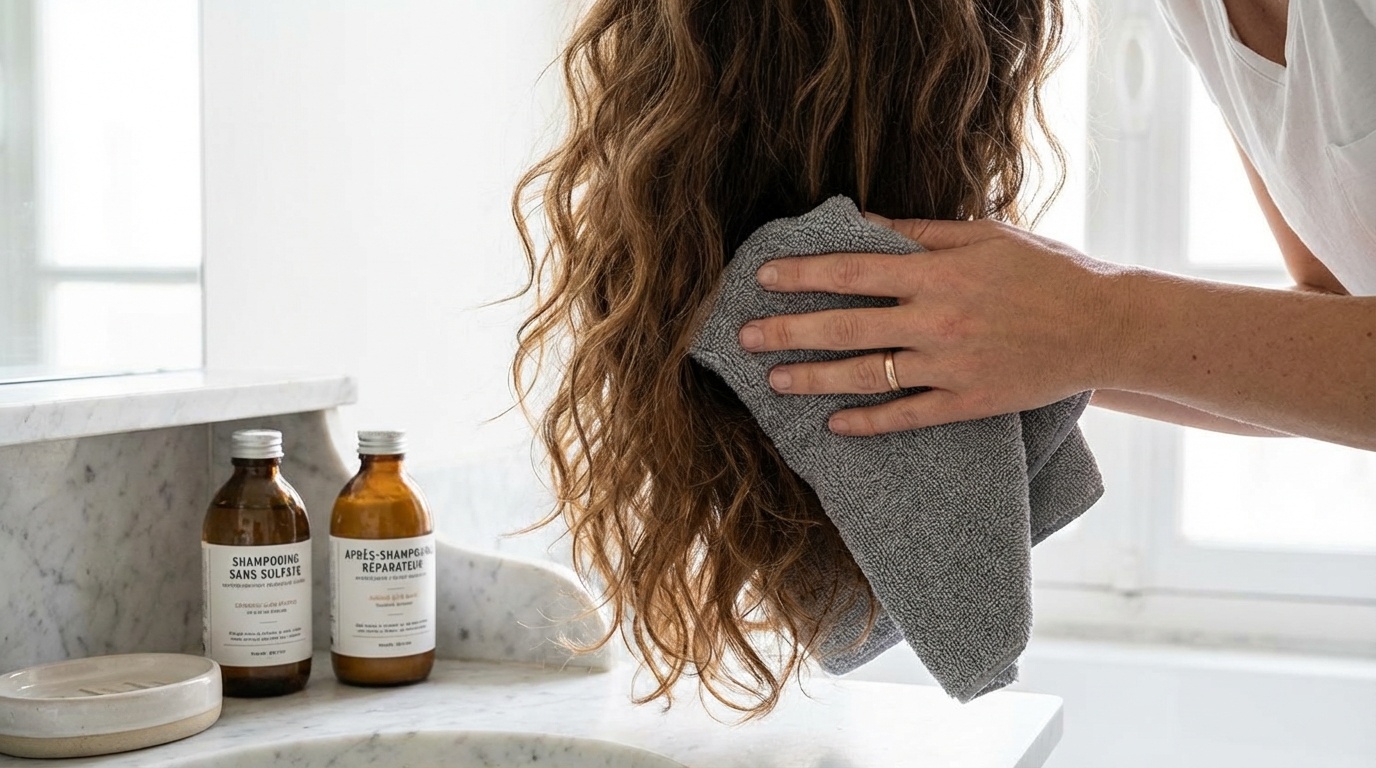
Dry brushing makes the situation worse, especially on curly or sensitized hair. By separating each strand, it breaks definition and creates a cloud of little electric hairs. It is better to wring out by pressing with a microfiber towel or a t-shirt, then detangle on wet hair with conditioner, with your fingers or a wide-toothed comb. On the drying side, warm air directed from the roots to the ends and a touch of protective care clearly limits frizz.
Mistake #3: skipping treatments that seal in moisture in porous hair
A shampoo, even a well-chosen one, is not enough to treat dry hair. Beauty editors who have tested oil baths or two-phase serums on thin and damaged lengths describe hair that is more supple, shiny and less dull after a few uses, provided you have a light hand. Hairdressers who support the transition to gray hair also emphasize the importance of a moisturizing leave-in and sulfate-free products for lightened hair that tends to become rough and frizzy.
To prevent dry, porous and frothy hair from remaining so, a regular mini routine changes everything: an oily pre-shampoo treatment on the lengths once a week, a gentle shampoo, a systematic conditioner and a mask when the fiber seems rough. On towel-dried hair, a few drops of light oil or a leave-in treatment seal in hydration. With these repeated actions, the cuticles gradually smooth out, the porosity stabilizes and the strands swell less when drying.
Why does my hair get foamy when it dries?
Raised cuticles let water in and out too quickly, causing the fiber to swell. Aggressive washing, towel rubbing and lack of conditioning care maintain this porosity and give this swollen and dull appearance.
How to recognize porous hair?
Porous hair absorbs products very quickly, dries quickly but remains rough, with a lot of frizz. They lack shine, tangle easily and react strongly to ambient humidity.
Which shampoo to choose for dry and frothy hair?
Choose a gentle shampoo, without sodium laureth sulfate (SLES) or sodium lauryl sulfate (SLS), without Alcohol denat or mineral oils. It must clean without squeaking, leaving the lengths supple after rinsing.
Are oil baths suitable for fine hair?
Yes, as long as you use a small amount and rinse well with double shampoo. Applied as a pre-shampoo, a light oil bath improves suppleness without weighing it down, especially if you avoid formulas that are too rich in roots.
Sources
- Fashions & Works
“Vitamin B8: the foods that contain the most to prevent hair loss this fall”
