
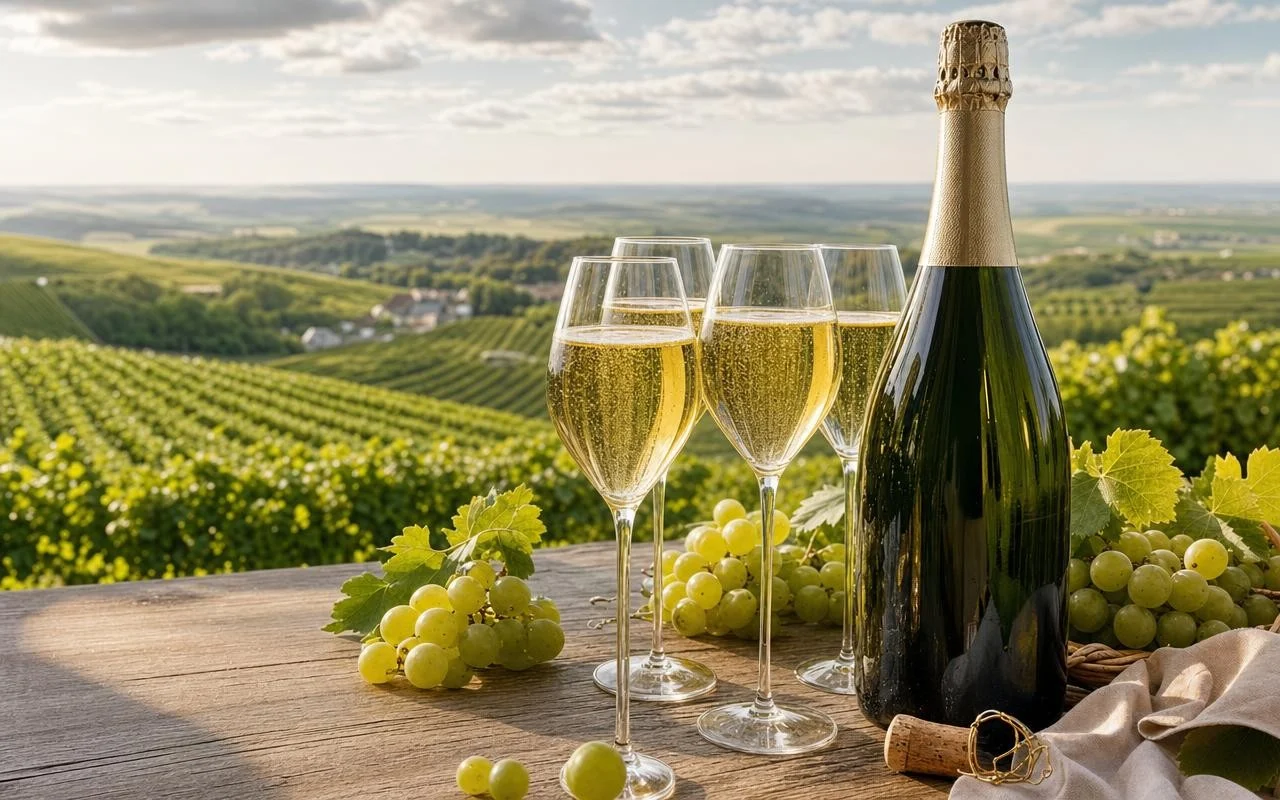
A champagne with 15% alcohol is more reminiscent of a still wine than a festive flute. However, the Champagne industry has just obtained a historic exemption which authorizes, for the 2026 vintage, bottles above 13%.
This decision responds to an extraordinary year, with grapes very rich in sugar and early maturity. The appellation asked the INAO to relax its specifications: this is what opens the door to a champagne with more than 13% alcohol, or even up to 15%.
Harvest 2026 in Champagne: an early and ultra-ripe vintage
The 2026 harvest promises to be one of the earliest ever observed. The first blows of pruning shears were given in mid-August, and even on August 6 in Montgueux. , says Sébastien Debuisson, director of the Research-Development division of the Champagne Committee, quoted by France 3. The president of the General Union of Winegrowers, Maxime Toubart, summarizes the situation: .
A mild winter, a shortened growing cycle and several heatwaves accelerated maturity. The grapes were loaded with sugar, raising the potential degrees well above average. , insists Sébastien Debuisson, who sees this as a grape made for exceptional vintages.
Why the 13% alcohol limit was no longer enough
In Champagne, the specifications normally limit the total alcoholic strength to 13%, once the mousse has set in the bottle. However, this second fermentation already adds around 1 to 1.5 degrees to the base wine. With very ripe musts, certain 2026 batches would have mechanically exceeded the authorized bar. However, Maxime Toubart assures that.
The inter-profession has therefore obtained a temporary modification: certain champagnes may be marketed above 13%, up to 15°. This will not be the norm, but a possibility offered to cellars which wish to promote these ripe juices. , underlines David Châtillon, co-president of the Champagne Committee, who hopes to see the birth of from this vintage.
Climate, new grape varieties and impact in the glass
For Maxime Toubart, this harvest heralds a near future more than an exception: . The adaptation is already underway. The profession also works with plant material: explains David Châtillon.
Managers are already talking about staggered picking times, even night-time harvests, and are not closing the door to the machine: , specifies David Châtillon. He also emphasizes that, despite the heat, . For consumers, the majority of bottles will remain around 12%, with only a few more alcoholic vintages clearly displaying their title on the label.
Will all bottles of champagne exceed 13% alcohol?
No, only a small portion of very ripe 2026 vintages will exceed 13%.
When will we be able to buy champagne at 15°?
After the foaming and aging in the cellar, these 2026 champagnes will only be marketed in a few years.
How can you tell that a champagne has more than 13% strength?
The alcohol content in % vol is always clearly indicated on the label.
