
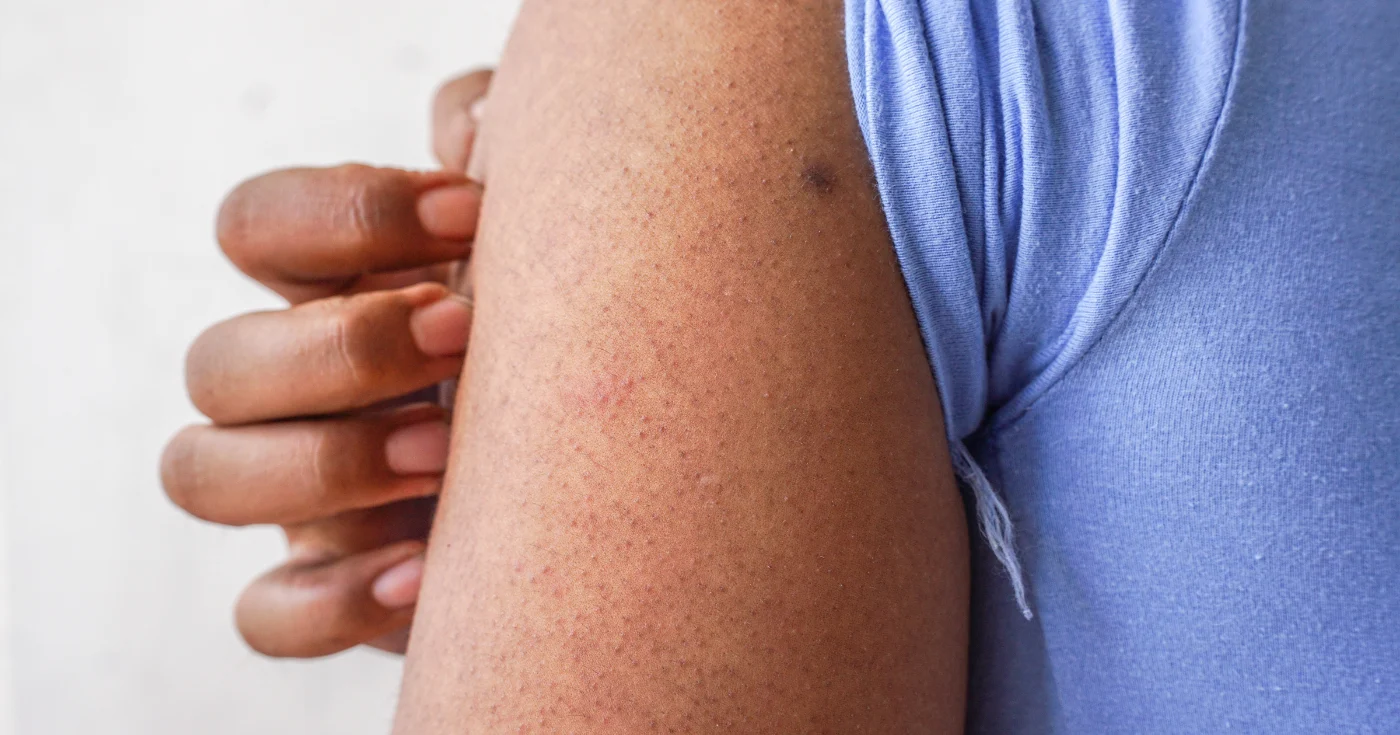
Keratosis pilaris is a benign skin condition that appears as small, rough bumps, sometimes red or lightly pigmented. They correspond to keratin plugs which obstruct the opening of the hair follicle, where the hair grows.
Although it is very common, this particularity of the skin is often confused with dry skin, ingrown hairs or what is commonly called “chicken skin” or “strawberry skin”. However, it is neither a hygiene problem nor a contagious disease.
Although its appearance can be unsightly or annoying on a daily basis, keratosis pilaris does not present any danger to health.
Why does it appear? A more complex mechanism than a simple excess of keratin
For a long time, keratosis pilaris was mainly described as a simple excess of keratin. In reality, researchers now know that its origin is more complex.
Keratin is a protein naturally produced by the skin. In affected people, it accumulates at the hair follicle and gradually forms a small plug which gives this grainy appearance to the touch.
But why does this accumulation occur?
A study published in 2015 in shed important light on the mechanism of keratosis pilaris. Researchers have shown that affected people very often have an absence or abnormality of the sebaceous glands around the hair follicle. However, these glands usually produce sebum, essential for maintaining a good skin barrier.
In the absence of this natural protection, the skin becomes more fragile, drier and more permeable. In response, it produces more keratin, thus promoting the formation of the famous follicular plugs. The authors also observed abnormalities of the hair shaft and the skin barrier, independently of a possible deficiency in filaggrin, a protein often involved in dry skin.
In other words, keratosis pilaris is not only linked to a “surplus of keratin”: it results from a set of alterations in the hair follicle and the skin barrier.
Which assets are best documented today?
Understanding this mechanism also allows us to better understand why certain actions are more effective than others.
Among the most studied ingredients, lactic acid is today one of the active ingredients benefiting from the best level of proof.
In the only randomized clinical trial to compare two keratolytics in people with keratosis pilaris, a formulation containing 10% lactic acid reduced lesions by 66% after 12 weeks of application, compared to 52% with 5% salicylic acid. Participants applied the treatment twice a day throughout the duration of the study.
It is important to clarify that these results concern lactic acid as an active ingredient, and not a particular cosmetic product.
It is precisely this concentration of 10% that we find in the keratosis pilaris cream developed by Thank You Lab.
The most recent scientific data points in the same direction. A systematic review published in 2025, having analyzed 27 studies devoted to keratosis pilaris, concludes that lactic and glycolic acids are among the best documented topical active ingredients for improving the appearance of this condition.
The objective of these treatments is not to “cure” keratosis pilaris, but to gradually help smooth the skin, while maintaining good hydration of the skin barrier.
Why Harsh Scrubs Aren’t Usually the Best Solution
Faced with rough skin, the first instinct is often to increase the number of mechanical scrubs.
However, this approach can be counterproductive.
Since keratosis pilaris is already accompanied by an alteration of the skin barrier, overly abrasive exfoliations risk accentuating irritation and redness without having a lasting effect on the mechanism causing follicular plugs.
Dermatologists generally recommend a gentler approach: favoring well-tolerated keratolytic active ingredients, combined with daily hydration and regular application over several weeks. Patience is essential, as results are gradual.
Beauty Test testers tell their experience
Beyond the scientific data, some users affected by keratosis pilaris shared their feelings after testing Thank You Lab’s Skin Restore treatment. These testimonials reflect personal experience and do not constitute clinical proof.
These returns illustrate the diversity of individual experiences. As with any cosmetic treatment, results may vary from one person to another depending on skin type, regularity of use and the severity of keratosis pilaris.
In summary
Keratosis pilaris is a benign condition, very common and much more complex than a simple excess of keratin. Scientific knowledge today shows that it is linked to abnormalities of the hair follicle and the skin barrier, explaining why aggressive scrubs rarely bring lasting improvement.
Conversely, keratolytic active ingredients such as lactic acid, particularly at the 10% concentration studied in clinical trials, are among the best-documented ingredients for gradually improving the appearance of the skin.
If keratosis pilaris does not disappear overnight, a gentle, regular and adapted routine often allows you to find smoother, more supple and more comfortable skin over the weeks.
Sources
- Gruber R, Sugarman JL, Crumrine D, Hupe M, Mauro TM, Mauldin EA, et al. Sebaceous gland, hair shaft, and epidermal barrier abnormalities in keratosis pilaris with and without filaggrin deficiency. Am J Pathol. 2015;185(4):1012-1021. https://pubmed.ncbi.nlm.nih.gov/25660180/
- Kootiratrakarn T, Kampirapap K, Chunhasewee C. Epidermal permeability barrier in the treatment of keratosis pilaris. Dermatol Res Pract. 2015;2015:205012. https://pubmed.ncbi.nlm.nih.gov/25802513/
- Beyron A. Keratosis pilaris: a systematic review of the literature and strategies for optimal treatment. Eur J Dermatol. 2025;35(5):387-393. https://pubmed.ncbi.nlm.nih.gov/41277649/
