
It’s a small, silent revolution that will change the daily lives of millions of women in France. Since the adoption of the measure in the Social Security financing law in December 2023, it will have taken nearly three years for the reimbursement of reusable periodic protection to finally become a concrete reality. This delay is explained by the complexity of the consultation carried out between public authorities, associations, pharmacists’ unions and manufacturers, all mobilized to define strict specifications guaranteeing the quality and effectiveness of eligible products.
From October 1, 2026, the first references of menstrual panties registered in the Health Insurance system will finally be able to be delivered in pharmacies. An advance that responds to a dual public health challenge: facilitating access to safe and durable protection, while actively fighting against menstrual precariousness which still affects too many women in France, particularly the youngest.
Who can benefit from this reimbursement?
The measure primarily targets two well-defined audiences. On the one hand, all women under 26, an age group particularly affected by the financial difficulties linked to the purchase of periodic protection, particularly high school and university students. On the other hand, the beneficiaries of the Complementary Health Solidarity (CSS), without any age condition, which considerably broadens the field of people concerned.
More good news: no prescription will be necessary to benefit from this reimbursement. All you need to do is present your Vitale card directly to the pharmacy at the time of purchase, which greatly simplifies the process and avoids a forced visit to the doctor, often seen as an additional barrier for young women.
What reimbursement amount and how much protection?
Concretely, Health Insurance will cover between 55 and 65% of the purchase price of panties and menstrual cups, the rest can be covered by complementary health insurance as part of responsible contracts. For CSS beneficiaries, the support increases to 100%, making access completely free for the most vulnerable groups.
The system provides reimbursement for up to two reusable protections per year, whether menstrual cups or panties. The renewal is calculated from the date of the first purchase, which leaves a certain flexibility in the organization of purchases throughout the year. Only references that have been validated by the authorities, according to an order from the Ministry of Health published in August 2026, will appear on the official list of eligible products.
Saforelle, market pioneer since 2019
Among the brands historically involved in this segment, Saforelle occupies a special place. In 2019, the brand became the very first to launch menstrual panties available in pharmacies, paving the way for a market that was then almost non-existent in this distribution channel. Seven years later, the brand claims a leading position with almost one in two menstrual panties sold in French pharmacies.
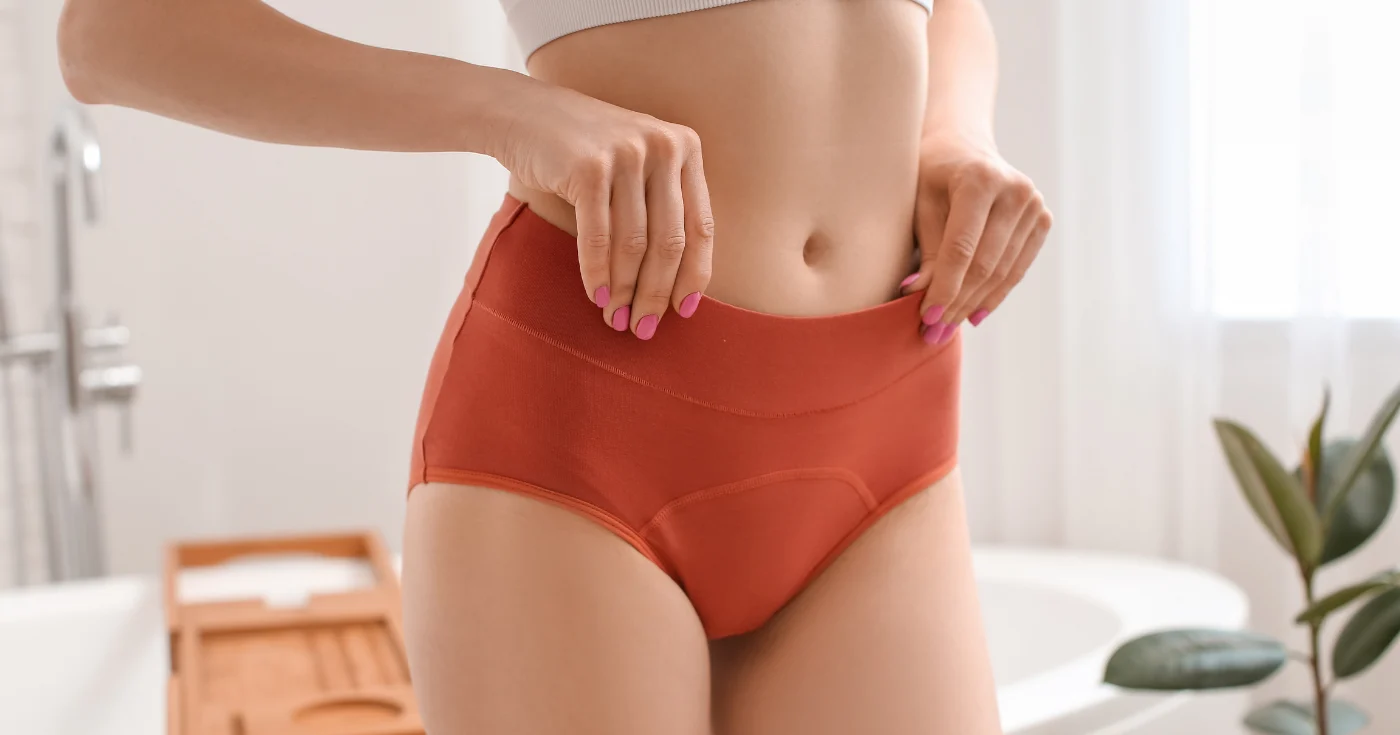
The Saforelle menstrual panties feature a technical design in three layers: a draining layer, an absorbent layer and a waterproof layer, all made from hypoallergenic organic cotton. Available in a wide range of sizes, from 12-14 years to accompany the first period up to 50, it offers an absorption capacity of at least 21 ml (the equivalent of four heavy-flow tampons) and up to 12 hours of protection. Its public price is set at 19 euros.
A long-standing commitment against menstrual poverty
Beyond the product launch, Biocodex, the laboratory which distributes Saforelle, has been mobilized for several years alongside associations such as La Maison des Femmes de Saint-Denis, Règles Élémentaires and the Bus des Femmes. Over the last two years alone, the brand has contributed to the distribution of more than 150,000 periodic protection products and nearly 200,000 intimate hygiene products, notably through the Agence du Don en Nature.
This commitment also involves an important educational component. For several years, Biocodex and Saforelle have been developing information tools intended to raise awareness of reusable menstrual protection, both among patients and healthcare professionals in pharmacies. An approach which has also earned the group the “Engaged CSR” label issued by AFNOR, recognizing a structured strategy in terms of social responsibility.
How to properly take care of your menstrual panties?
To guarantee the effectiveness and longevity of your menstrual panties, a few simple rules are necessary. Before the very first use, washing is essential. Then, after each cycle, the panties must be rinsed in cold water before being put in the machine at 40°C, without bleaching or softening agents, two products which could damage the absorbent technical layers.
Drying must be done in the open air, and it is not recommended to iron the panties, as this risks damaging their absorption and waterproofing properties. Well maintained, quality menstrual panties can accompany their users for several years, which makes them, beyond the public health aspect, a particularly interesting solution from an ecological and economic point of view in the long term.
FAQ: everything you need to know about reimbursement for menstrual panties
From what date are menstrual panties reimbursed?
Reimbursement comes into effect on October 1, 2026, the date on which the first validated references will be available in pharmacies.
Who can benefit from reimbursement for reusable menstrual protection?
All women under 26, as well as beneficiaries of the Complementary Health Solidarity (CSS), regardless of age for the latter.
Do you need a prescription to be reimbursed for menstrual panties?
No, no prescription is necessary. Simply present your Vitale card at the pharmacy at the time of purchase.
What is the reimbursement amount?
It is between 55 and 65% for women under 26, and 100% for CSS beneficiaries.
How many reusable protections can be reimbursed per year?
Up to two protections (panties or menstrual cups) can be reimbursed each year, with renewal calculated from the date of first purchase.
Are all brands of menstrual panties affected?
No, only references who have validated their file with the authorities, in accordance with the specifications of the Ministry of Health, appear on the official list of reimbursable products.
