
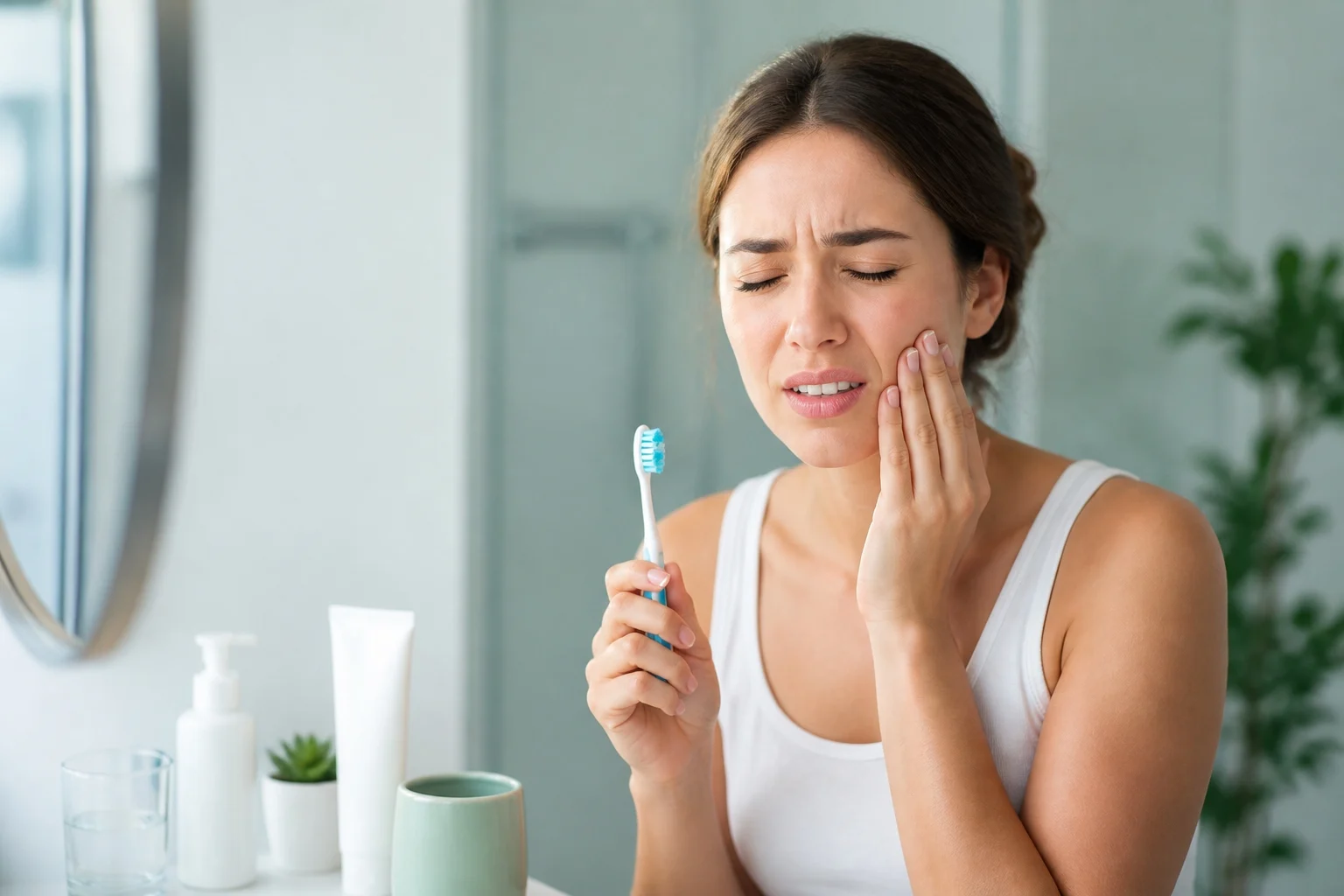
Why teeth become sensitive after whitening
Sensitivity after whitening occurs when the tooth reacts more strongly to usual stimuli, including cold, heat, air or certain acidic foods. Whitening, whether carried out in the dental office or at home, can cause temporary irritation linked to the diffusion of lightening agents. This reaction does not automatically mean that a tooth is damaged, but it warrants a careful routine, focused on comfort, protection of the enamel and observation of the evolution of symptoms.
Pain related to tooth sensitivity is often distinguished from deeper structural pain. Diffuse, brief and cold-triggered sensitivity does not have the same profile as spontaneous, throbbing or persistent pain. When the discomfort lasts several weeks, concentrates on a single tooth or worsens at night, dental advice becomes necessary to rule out a cavity, a crack, a gum problem or another local cause.
What routine to adopt in the days following whitening
The most helpful routine after whitening relies on reducing irritants and maintaining regular hygiene. The goal is not to stop brushing, but to avoid aggressive actions that maintain the pain. A soft brush, toothpaste formulated for sensitive teeth and non-abrasive brushing form the basis. Very cold, very hot or acidic drinks can increase discomfort during this period of increased reactivity.
A simple routine can be organized around a few concrete benchmarks:
-
Use a soft toothbrush to limit friction on the enamel and cervical areas.
-
Choose a fluoridated toothpaste intended for sensitive teeth, without having to change the formula from one day to the next.
-
Avoid highly acidic foods and drinks for the first few days if the pain is severe.
-
Favor gentle brushing, twice a day, without excessive pressure.
-
Monitor the development of the discomfort, especially if it becomes localized or persistent.
Which toothpaste to choose when teeth are sensitive after whitening
The choice of toothpaste depends on the type of sensitivity observed and the general condition of the mouth. For sensitivity after whitening, formulas intended for sensitive teeth are generally preferred, with special attention paid to fluoride and enamel protection. Fluoride occupies an important place in the daily routine, because it participates in the remineralization of the tooth surface and in caries prevention, without responding alone to all possible causes of pain.
In this context, the main criterion is not the brand message, but the adequacy between the formula, individual tolerance and regularity of use. Changing the product too quickly after a few days can confuse the evaluation. A gentle, fluorinated formula designed for daily use often remains more relevant than a succession of tests without a method.
|
Criteria |
Why it matters after whitening |
|---|---|
|
Sensitive teeth formula |
It aims to reduce reactivity to thermal and tactile stimuli. |
|
Presence of fluoride |
Fluoride supports enamel protection and cavity prevention. |
|
Moderate abrasiveness |
A formula that is too abrasive can lead to discomfort after treatment. |
|
Daily use |
Regularity is more important than frequent toothpaste changes. |
|
Good tolerance |
An irritated mouth copes better with a simple and stable routine. |
How to integrate sensitive toothpaste into your routine after whitening
After whitening, tooth sensitivity can be addressed from several angles: pain relief, enamel protection, fluoride intake and daily use. For people comparing the options available in 2026, the challenge consists above all of understanding what is expected of the product: calming transient sensitivity after whitening, maintaining good hygiene or supporting a mouth already weakened by erosion, heavy brushing or receding gums.
In all cases, the benefit of a suitable toothpaste is part of a regular and consistent routine. This position is relevant for daily maintenance, but it does not replace the evaluation of a dental surgeon when the pain becomes atypical. A toothpaste for sensitive teeth can therefore be integrated into the routine, without this exempting from a diagnosis if the sensitivity does not follow a usual course after whitening.
What signs should make you consult a dentist
Sensitivity after whitening is often temporary, but certain signs mean that the pain should not be trivialized. Discomfort that lasts, that wakes you up at night, that intensifies or that seems to come from a single tooth may be due to another cause. A cavity, a crack, pulp inflammation, a recent restoration or a gingival problem can produce similar pain, with different mechanisms. The duration and localized nature of the pain are therefore important benchmarks.
The following situations warrant a consultation:
-
Pain persisting beyond a few days without clear improvement.
-
Spontaneous, throbbing or present pain without contact with cold or heat.
-
Sensitivity concentrated on a single tooth after whitening.
-
Discomfort associated with swelling, fever, or pain when chewing.
-
Worsening at night or when lying down.
What mistakes often make tooth sensitivity worse
Several habits can prolong discomfort after whitening. The first reflex to avoid is to rub more, thinking you will clean better. Heavy brushing, a hard brush or very abrasive toothpaste can increase the reactivity of the teeth. The other common mistake consists of multiplying products, alternating whitening, very different toothpastes and irritating mouthwashes. A sensitive mouth generally tolerates a short, consistent and stable routine better for a few days.
Faced with this challenge, oral hygiene products intervene in a specific framework: that of daily maintenance. Toothpaste should not be presented as a universal answer to all dental pain. When sensitivity returns despite an adapted routine, the question is not necessarily to choose a stronger formula, but to check whether the pain corresponds to post-whitening sensitivity and not to another dental problem.
FAQs on Sensitivity After Bleaching
Is sensitivity after bleaching normal?
Yes, sensitivity after bleaching is common when it remains brief, moderate and triggered by cold, heat or air.
Sensitivity after whitening often corresponds to a transient reaction of the tooth to lightening agents. This discomfort may appear in the hours or days following the treatment, then gradually diminish. Diffuse, short pain does not have the same meaning as intense, spontaneous or persistent pain. If the discomfort persists, becomes localized or worsens, a dental check-up makes it possible to look for a cause other than simple post-treatment sensitivity.
What toothpaste to use after teeth whitening?
A fluoridated toothpaste formulated for sensitive teeth is usually the most consistent choice after whitening.
After whitening, the priority is to limit irritation while maintaining regular hygiene. A formula intended for sensitive teeth, with fluoride and moderate abrasiveness, responds better to this period of fragility than a very whitening or very stripping toothpaste. The essential point remains regularity of use and good tolerance. A stable routine helps more than a quick succession of different products.
How long does sensitivity last after bleaching?
Sensitivity after bleaching often lasts a short time, but its exact duration varies depending on the person and the technique used.
The duration depends on several factors: initial state of the enamel, intensity of whitening, presence of erosion, eating habits and way of brushing your teeth. Mild discomfort that gradually diminishes is compatible with an expected reaction. On the other hand, pain that persists for several weeks, which reappears strongly or which is concentrated on a single tooth should not be automatically attributed to whitening. A consultation then makes it possible to clarify the origin of the pain.
Does fluoride help with tooth sensitivity after whitening?
Yes, fluoride has a useful role in protecting enamel, but it is not a substitute for evaluating unusual pain.
Fluoride is an important benchmark in daily oral hygiene, because it contributes to the remineralization of the tooth surface and the prevention of cavities. After whitening, this protective function may be particularly relevant if the teeth react more to stimuli. On the other hand, fluoride alone does not explain any management strategy. Intense, nocturnal or localized pain may be due to another problem that requires a clinical examination.
Should you stop brushing when your teeth are sensitive?
No, you should not stop brushing, but you should adopt a gentler and better brushing style.
Interrupting brushing exposes you to an accumulation of plaque, which can complicate the oral situation. Instead, the right approach is to reduce pressure, use a soft brush, and choose a toothpaste designed for sensitive teeth. A gentle, regular and non-abrasive action protects better than vigorous cleaning. If the simple touch of the brush becomes very painful, it is better to seek dental advice rather than changing the entire routine on your own.
When should you consult if the pain returns despite toothpaste for sensitive teeth?
You should consult if the pain persists, worsens or no longer resembles a simple sensitivity triggered by the cold.
The return of pain despite using toothpaste for sensitive teeth does not automatically mean a stronger formula is needed. The main question is whether the pain still corresponds to classic tooth sensitivity. Spontaneous, nocturnal pain localized to a tooth or associated with chewing may suggest another cause. In this case, toothpaste remains a hygiene support, but it does not replace a diagnosis made by a professional.
