
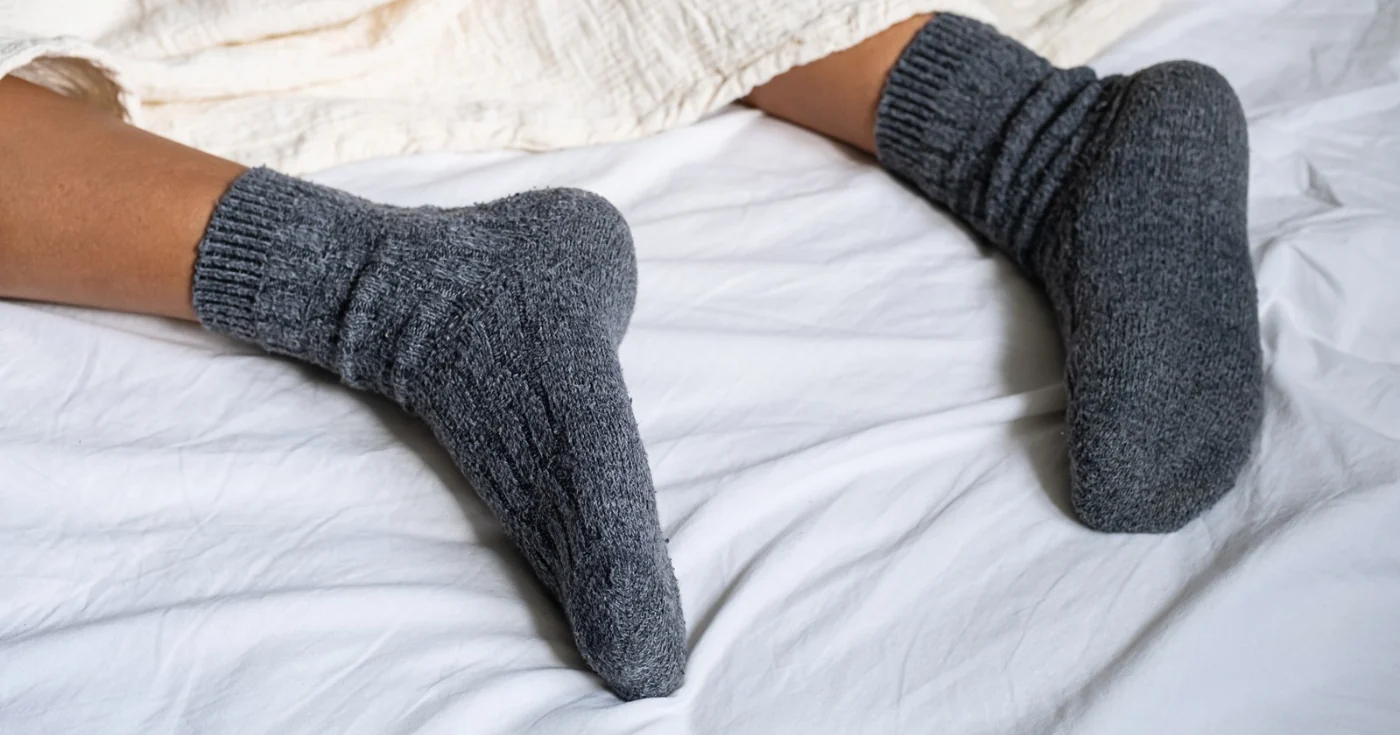
We tend to take off our socks before slipping under the duvet. However, this little habit could well deserve a place in our evening ritual. While the idea of sleeping with covered feet may seem uncomfortable to some people, it has interested sleep researchers for several years. And for good reason: keeping your feet warm could help the body fall asleep more quickly.
It’s not just about comfort. Scientific work has in fact highlighted a link between the temperature of the body’s extremities and the speed of falling asleep. Even more surprising, a study published in 2018 directly evaluated the effects of wearing socks at night. Its results make you want to review some of our bedtime habits.
Why might having warm feet help you fall asleep?
To understand this phenomenon, we must look at thermoregulation, in other words the way in which our body regulates its temperature. Contrary to what one might think, the body needs to slightly lower its core temperature to prepare for falling asleep. This natural process is notably accompanied by an increase in blood circulation to the extremities, particularly the hands and feet. The blood vessels then dilate, which allows the body to dissipate more heat.
This mechanism was notably studied by Swiss researchers in a publication published in the scientific journal, September 2, 1999. Entitled “Warm feet promote the rapid onset of sleep”, this study shows that the dilation of blood vessels in the hands and feet constitutes a particularly relevant physiological indicator of the speed of falling asleep. In other words, when the extremities are warm enough to promote heat exchange, the body seems more willing to sleep. A discovery which provides a scientific explanation for the potential benefit of socks in bed.
Source: Kräuchi K. et al., Nature, 1999. Consult the study.
Sleeping with socks: study reveals surprising results
But have researchers gone so far as to actually test this habit? Yes ! In 2018, Yelin Ko and Joo-Young Lee, researchers at Seoul National University, published a study in the , dedicated to the effects of warming the feet during sleep. Their objective: to determine if wearing socks could really influence the quality of the night.
To carry out their experiment, they followed six young men, aged on average 22.7 years, during two experimental nights: one with socks, the other without. Participants slept for seven hours in a room kept at 23°C. The researchers then compared several parameters, including the time it took to fall asleep, the total sleep time and the number of nighttime awakenings. The results were particularly interesting: with socks, participants fell asleep on average 7.5 minutes faster and slept 32 minutes longer. The number of awakenings also fell from 16.3 to 8.8 on average over the seven hours observed. Finally, sleep efficiency, that is to say the proportion of time spent in bed actually spent sleeping, increased from 86.2% to 93.8%.
Source: Ko Y. and Lee J.-Y., Journal of Physiological Anthropology, April 24, 2018. Consult the full study.
Can socks really fight insomnia?
These results are encouraging, especially for people who have difficulty getting to sleep. However, an important nuance must be made: the 2018 study only included six young men, with no known sleep disorders. It therefore does not allow us to conclude that wearing socks constitutes a treatment for insomnia. It simply suggests that warming the feet could be a complementary aid to make it easier to fall asleep and promote certain sleep parameters. Further research, carried out on larger populations and in particular on people suffering from insomnia, would be necessary to confirm these observations.
In the event of chronic insomnia, socks cannot replace real care. On this subject, the American Academy of Sleep Medicine recommends in particular cognitive-behavioral therapy for insomnia (CBT-I), the effectiveness of which is supported by a much larger number of scientific studies. But for those who simply have cold feet when going to bed or who take a long time to fall asleep, this little tip costs almost nothing and is worth trying. Provided, of course, that you don’t get too hot!
Additional source: Edinger JD et al., Journal of Clinical Sleep Medicine, 2021. Consult the recommendations.
Which socks to choose for sleeping?
If you want to try the experience, there is no need to invest in socks specially designed for sleeping. The main thing is to prioritize comfort and not hinder blood circulation. Opt for a pair that is clean, soft, loose enough and made from a breathable material, such as cotton or merino wool. Avoid models that are too tight at the ankles or thick socks which could make you too hot during the night.
The goal is not to overheat the feet, but simply to maintain a pleasant temperature. If you’re sweating, feeling uncomfortable, or naturally hot at night, it’s obviously better to take them off. And if you regularly suffer from sleep problems, don’t hesitate to talk to a health professional.
FAQ: Sleeping with Socks
1. Is it good to sleep with socks every night?
Yes, if it makes you comfortable. There is no general contraindication to wearing socks at night in a healthy person. Just be sure to choose a model that is clean, breathable and does not compress your feet.
2. Does sleeping with socks help you fall asleep faster?
Some scientific data points in this direction. A study published in 2018 notably observed an average reduction of 7.5 minutes in the time it took to fall asleep in six men wearing socks while they slept.
3. Can socks cure insomnia?
No. Although they can help improve thermal comfort and potentially make it easier to fall asleep, no study shows that they can treat chronic insomnia. Appropriate treatment, in particular cognitive-behavioral therapy for insomnia, remains recommended.
4. What material should you choose for sleeping with socks?
Cotton and merino wool are good options, as they help maintain a comfortable feeling without retaining too much moisture. Above all, favor flexible models without too tight elastic.
5. Should you wear socks even when it’s hot?
No, that’s not necessary. The benefit of this habit is in particular to warm the feet when they are cold. If the room temperature is high or you tend to sweat during the night, it is better to sleep barefoot.
