
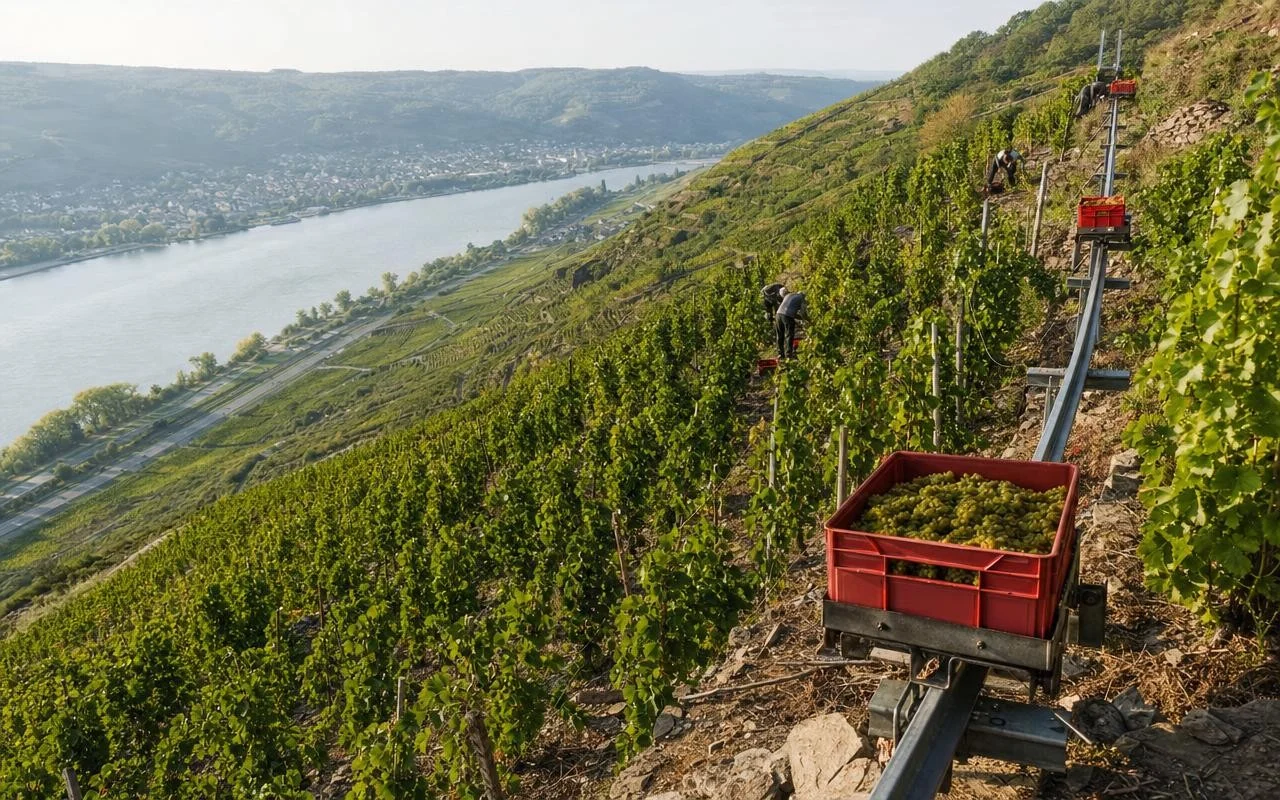
Overlooking the right bank of the Rhône, the rows of Côte-Rôtie vines almost form a wall. The grape pickers advance sideways, their feet propped up against the stone walls, with a 60% slope under the soles. There, recently, a metal cabin has been sliding between the vines. The scene intrigues as much as it fascinates.
In Ampuis, the historic heart of the appellation, a winegrower chose the monorail to hoist the bins of Syrah. Others tinkered with winches and zip lines. In this vineyard, one of the steepest in France, the harvest remains 100% manual, but mechanical skill becomes essential.
In Côte-Rôtie, a vertical vineyard for acrobatic harvests
Here, slope viticulture is not new: vines have been cultivated for nearly twenty-four centuries on these schist and granite hillsides. The AOC Côte-Rôtie, created in 1940, covers around 350 hectares distributed between around a hundred winegrowers, on narrow terraces supported by dry stone walls.
With slopes of up to 60%, mechanization remains impossible. All year round, each task is done by hand, from trellising to pruning. At harvest time, porters used to lower boxes weighing 10 to 20 kilos on this steep and stony terrain, with extreme fatigue and a permanent risk of falling.
Stéphane Ogier’s monorail, a gentle revolution for carriers
To alleviate this work, three years ago, winegrower Stéphane Ogier installed a monorail on one of his steepest plots in Ampuis. On each trip, the skip brings down nearly 200 kilos of grapes in a few minutes instead of eight porters. , explains Stéphane Ogier to France 3 Rhône-Alpes.
On the line, the pickers gain in security as well as time. Seasonal worker Anthony Brau summarizes: . Pointing to the slope behind him, he adds:
Winches, zip line and the future of a heroic vineyard
Other areas of Côte-Rôtie have adopted cable rather than rail. Since 1978, winemaker Nicolas Gay has used a sled hoisted by a winch which brings up around 450 kilos of grapes per trip, or nearly 6 tonnes in less than a week. When the bins are full, everything depends on one gesture: explains Nicolas Gay. , confirms Evan Martel, sales manager for the area.
Around, the solutions compete in ingenuity. On certain plots, a grape harvest zip line transports the 20 kilo bins along a cable of around 80 meters, while older wine monorails continue to be used on the most inaccessible hillsides. With warmer summers and shortened harvest windows, these systems help estates bring in intact grapes more quickly, without calling into question the obligation of manual harvesting.
- Vineyard monorail: a motorized skip follows a rail fixed between the rows and transports the boxes down.
- Winch and sled: a tray slides down the slope and lifts several hundred kilos with each rotation.
- Harvest zip line: a cable stretched above the vines allows you to hang skips weighing around 20 kilos.
How do monorail harvests work in Côte-Rôtie?
The monorail transports the already filled boxes from the steepest rows to the bottom of the plot. The harvesters always cut the bunches by hand, in accordance with the appellation’s specifications.
Are the harvests in Côte-Rôtie really entirely manual?
Yes, the grape harvest is done by hand, pruning shears in hand for each bunch. The monorails, winches or zip lines are only used to transport the bins, not to cut the grapes.
Can you attend these acrobatic grape harvests during a stay in Ampuis?
The plots often border the road or the ViaRhôna, which allows you to see the grape pickers, the rails and the cables from public paths, while of course respecting the work of the teams on site.
