
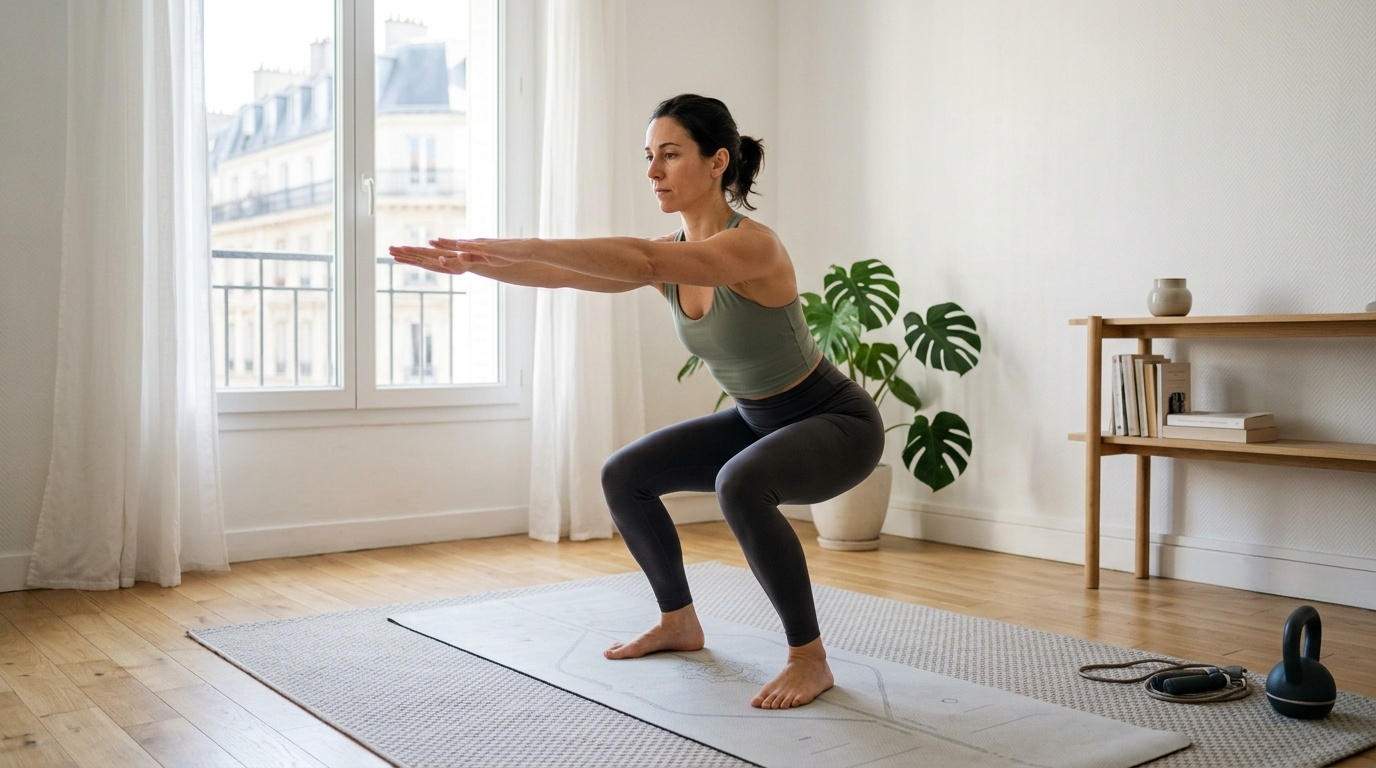
A mat, some floor space and your own body: sometimes that’s all it takes to sculpt a stronger figure. Calisthenics, a minimalist workout that is a hit on the networks, brings up to date an idea more than a century old: building muscle without weight or machines, drawing inspiration from the principles of Swedish gymnastics.
Born in the 19th century, calisthenics long served as a basis for school or military training before inspiring today’s street workout. Today, it returns to our living rooms as a sport without equipment that promises to strengthen the entire body. But what really distinguishes it from a classic fitness session, and how can you adopt it at home without getting injured or discouraged?
Calisthenics and calisthenics: same DNA, different goals
Calisthenics, also called , is described as a muscle-strengthening workout that mixes gymnastics and bodyweight strength training. You use your own weight as resistance to develop strength, without equipment. Squats, lunges, push-ups, pull-ups, burpees, dips and even core training: these polyarticular movements constitute the basis of this practice.
For its part, the Swedish gym, structured in 1813 by Pehr Henrik Ling, is also based on 100% body weight work, rhythmic and controlled. The sessions alternate gentle cardio, strengthening, mobility and posture, with global gestures, synchronized breathing and moderate intensity. Calisthenics takes this foundation but pushes more towards strength and control of the body in space, with objectives such as strict traction, plank or muscle-up.
Why calisthenics without equipment really strengthens the whole body
Instead of using machines, calisthenics is based on a series of simple exercises that work arms, shoulders, back, core, glutes and legs in the same sequence. This variety allows you to target all muscle groups and work the abdominal muscles in depth. The discipline develops strength, endurance and power, while improving coordination, balance, suppleness and flexibility.
And then, no need for a gym: “Our body is our tool”, as some coaches summarize. This approach lends itself perfectly to training at home or outdoors, with a small base of key movements:
- Squats and lunges for legs and glutes
- Push-ups and dips for the chest and triceps
- Australian pull-ups or pull-ups for the back
- Board and lateral core support
Start calisthenics at home inspired by Swedish gymnastics
For a sustainable practice, the logic of Swedish gymnastics remains an excellent compass. A typical session lasts 45 to 60 minutes, with 6 to 8 minutes of warm-up, a rhythmic cardio block, a bodyweight strengthening block then 5 to 10 minutes of mobility and stretching. Experts often recommend 2 to 4 sessions per week to progress while giving the body time to recover.
In calisthenics, progression is done less by adding weight than by playing on the amplitude, the time under tension, the rest duration or the difficulty of the supports. We start with accessible variations (push-ups against a wall, horizontal pull-ups under a table, low-amplitude squats), then we gradually become more complex. The idea remains the same as in Swedish gymnastics: move with control, respect your technique and listen to your joints, rather than chasing repetitions at all costs.
Is calisthenics without equipment suitable for beginners?
Yes, because the exercises come in many easier variations: push-ups against a wall, partial squats, horizontal pull-ups, kneeling. By adjusting the amplitude and support, calisthenics becomes a gentle gateway to muscle strengthening.
Do you absolutely need a pull-up bar to practice calisthenics?
No, you can start without equipment, focusing on push-ups, squats, lunges, chair dips and cores. A pull-up bar or a low bar simply allows you to enrich your back work and then progress to more advanced movements.
How many calisthenics sessions per week to see results?
Taking inspiration from the rhythm of Swedish gymnastics, aiming for 2 to 4 sessions per week offers a good balance between progress and recovery. With this frequency, most people quickly feel more strength, better posture and increased ease in everyday activities.
