
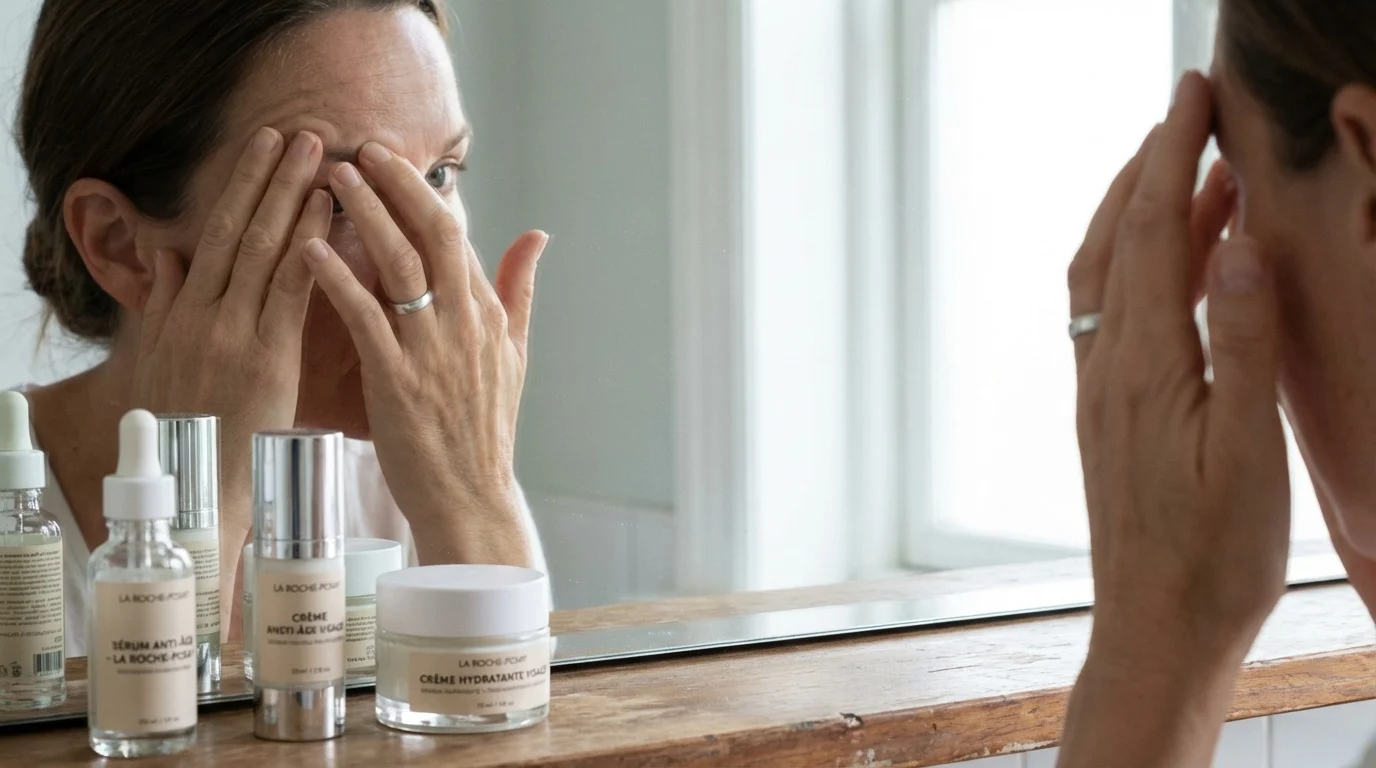
For years, many women swore it would be over: no more Botox, no more needles to smooth out even the slightest wrinkle. They focused on treatments, SPF, facial gym and a certain letting go. Then around the age of 46, the mirror suddenly reveals a deeper, more tired, almost foreign face.
This shift often coincides with perimenopause: estrogen drops, collagen too, volumes melt, the oval becomes blurred. Many describe feeling like they “took ten years” in just a few months. And there, the question of Botox after 40 comes back, between the desire to remain yourself and the fear of letting everything fall apart.
When Botox goes to the extreme for Gwyneth Paltrow and Bryan Johnson
At 53, Gwyneth Paltrow shows an almost unchanged face since . The actress admitted to having undergone a plasma exchange in a Chicago clinic, billed at £36,000, or several tens of thousands of euros, presented as a regeneration cure. A technique intended for serious burn victims or immunocompromised people; , abounds the French Blood Establishment.
In the same spirit, entrepreneur Bryan Johnson made his 17-year-old son his “blood boy”, swallowing 120 capsules per day, following a low-calorie diet and injecting himself with hormones, collagen and botox to defy time. Just like Ozempic, a drug for diabetics that has become a “slimming solution”, these practices reinforce the idea that one should try everything to stay young, even though, according to cited statistics, those aged 18 to 34 already resort to cosmetic surgery more than those over 50.
What Botox after 40 really changes on the face
Aesthetic medicine doctors after the age of 40 point out that botulinum toxin acts mainly on expression lines: frown lines, forehead folds, crow’s feet. Practitioners explain that the effect appears in three to seven days and lasts on average four to six months, often with one to two sessions per year to maintain the result. At this age, many recommend combining it with hyaluronic acid injections to compensate for the loss of volume.
Some clinics speak of a “light medical facelift” when we combine Botox after 40, hyaluronic acid and sometimes lasers, to relax without freezing. Health media, however, point out that repeated Botox raises questions: how does a face evolve after five, ten or twenty years of injections, should we lighten up, take breaks, switch one day to “notox” and toxin-free alternatives. The issue then becomes less about rejuvenating than keeping control of one’s image.
Resumption of Botox after 40: between Lisa Kudrow and your own limits
In Hollywood, Lisa Kudrow chose the other option. The star confides: She adds, however: , she explained in The Hollywood Reporter. Her hesitation clearly illustrates this gray area where many women find themselves after the age of 45.
Before restarting injections, beauty magazines remind us that it is important to clarify your motivations. Some questions often come up:
- Do I do it for myself or for the eyes of others?
- Am I ready to accept the result if I don’t like it?
- Do I have the budget and the desire for regular monitoring?
- Have I found a practitioner willing to say no if I ask too much?
It is these answers, and not the date of birth written on the identity card, which really determine the “yes” or “no” to Botox after 40 years.
From what age should you consider Botox after 40?
Specialists estimate that around the age of 40, Botox becomes primarily a tool for softening established wrinkles and preserving a rested appearance, rather than a very long-term preventive gesture.
How long do the effects of Botox last after 40?
Practitioners describe a visible effect in a few days, which lasts on average for four to six months, often with one or two sessions per year to maintain the same level of results.
Is repeated Botox risky for facial expression?
Health articles point out that years of Botox can modify certain expressions, hence the importance of dosing with caution, taking breaks and regularly discussing progress with your doctor.
