
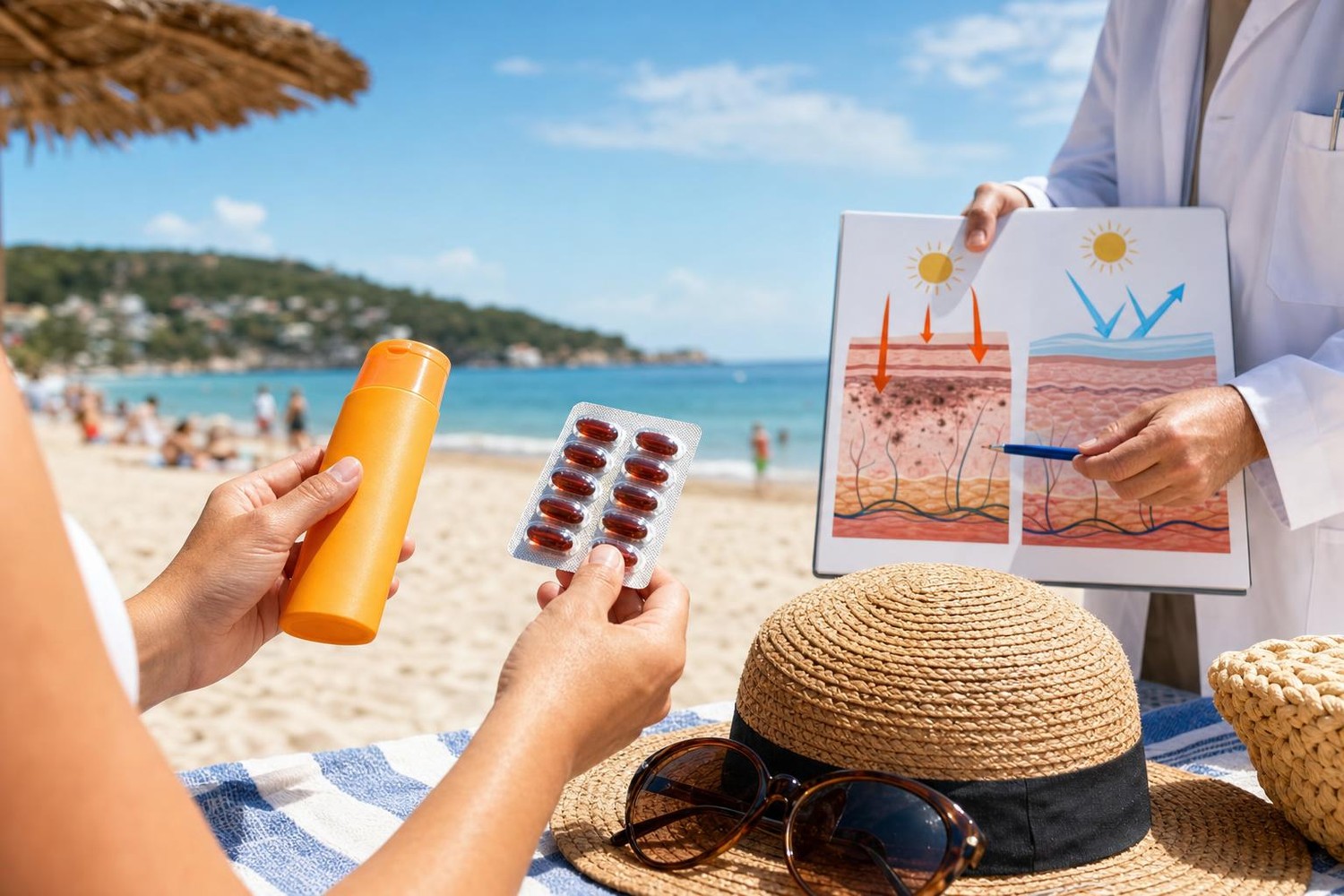
One capsule swallowed at breakfast, and you sometimes think you’re protected for the whole day, without a greasy film or touch-ups of sunscreen. On TikTok and Instagram, these “SPF capsules” are presented as the miracle solution for tanning in peace, even during the hottest hours. The idea appeals, especially when you have sensitive skin or hate sunscreen textures.
Behind the buzz, sun food supplement brands promise to “prepare” the skin with antioxidants, carotenoids and vitamins that support natural defenses against UV rays. An internal action which gives rise to a very simple question: can these capsules really replace protection applied to the skin?
Sun food supplements and oral SPF: what dermatologists say
The answer from specialists is very clear: no. The capsules do not block UV rays and have no measurable SPF rating. They do not provide chemical filters or mineral filters capable of absorbing or reflecting ultraviolet rays on the surface of the skin. , explained Shereene Teymour, dermatologist in New York, in an interview with the magazine.
These products play another role. They provide antioxidant molecules – beta-carotene, lycopene, lutein, vitamins C and E, selenium or zinc – which help the body to better manage oxidative stress induced by UV rays. As summarized by dermatologist Whitney Hovenic, Mohs surgeon, . They can therefore support the skin, but not protect it like a sun filter.
A possible support, never a substitute for sunscreen
In certain very specific situations, “sun preparation” supplements can be offered as reinforcement: skin very reactive to the sun, melasma or other hyperpigmentations, photosensitive diseases, history of skin cancers. Here again, always on medical advice, and with one idea in mind: even in these cases, the skin does not become “immune” against sunburn or UV-induced lesions.
The health authorities are also cautious. Since 2012, European regulations have prohibited supplements containing carotenoids or selenium from claiming protection against UV rays. A large French study, SU.VI.MAX, also observed that prolonged daily supplementation with antioxidants (vitamin C 120 mg, vitamin E 30 mg, beta-carotene 6 mg, selenium 100 µg, zinc 20 mg for more than 7 years) was associated with a four-fold increase in the risk of skin cancer in certain women. A reminder that a capsule is not a harmless shield.
How to combine SPF supplements and sunscreen without making a mistake
Pharmacists generally recommend starting a treatment two to four weeks before the first exposures, then continuing it during the sunny period. At the same time, the diet must remain rich in colorful fruits and vegetables, and careful hydration, because ultimately it is these habits that really nourish the skin on a daily basis.
The basis of photoprotection remains unchanged: a broad-spectrum cream, with an index of at least SPF 30, applied in sufficient quantity, renewed every two hours outdoors and after swimming or heavy sweating. And then, simple gestures complete this essential barrier:
- avoid the sun between 12 p.m. and 5 p.m. when it is strongest;
- wear a hat, covering clothing and sunglasses;
- never directly expose young children.
If you still wish to use “solar” capsules, it is better to seek help from a doctor or pharmacist, check the doses of carotenoids or selenium, and avoid misleading statements such as oral SPF or “internal sunscreen”. These supplements remain an additional option, designed to support the skin, but in no case a free pass to expose yourself without protection.
Do sunscreen food supplements have a real SPF index?
No, they do not have a measured SPF rating and do not contain any filters capable of blocking UV rays on the skin’s surface.
When to start a course of sun supplements before the holidays?
Laboratories generally advise starting two to four weeks before the first exposures, then continuing throughout the entire period of sunshine.
Do sunscreen capsules allow you to tan without sunburn?
No, they do not protect against burns: only suitable sunscreen, combined with good exposure reflexes, really limits the risk of sunburn.
