
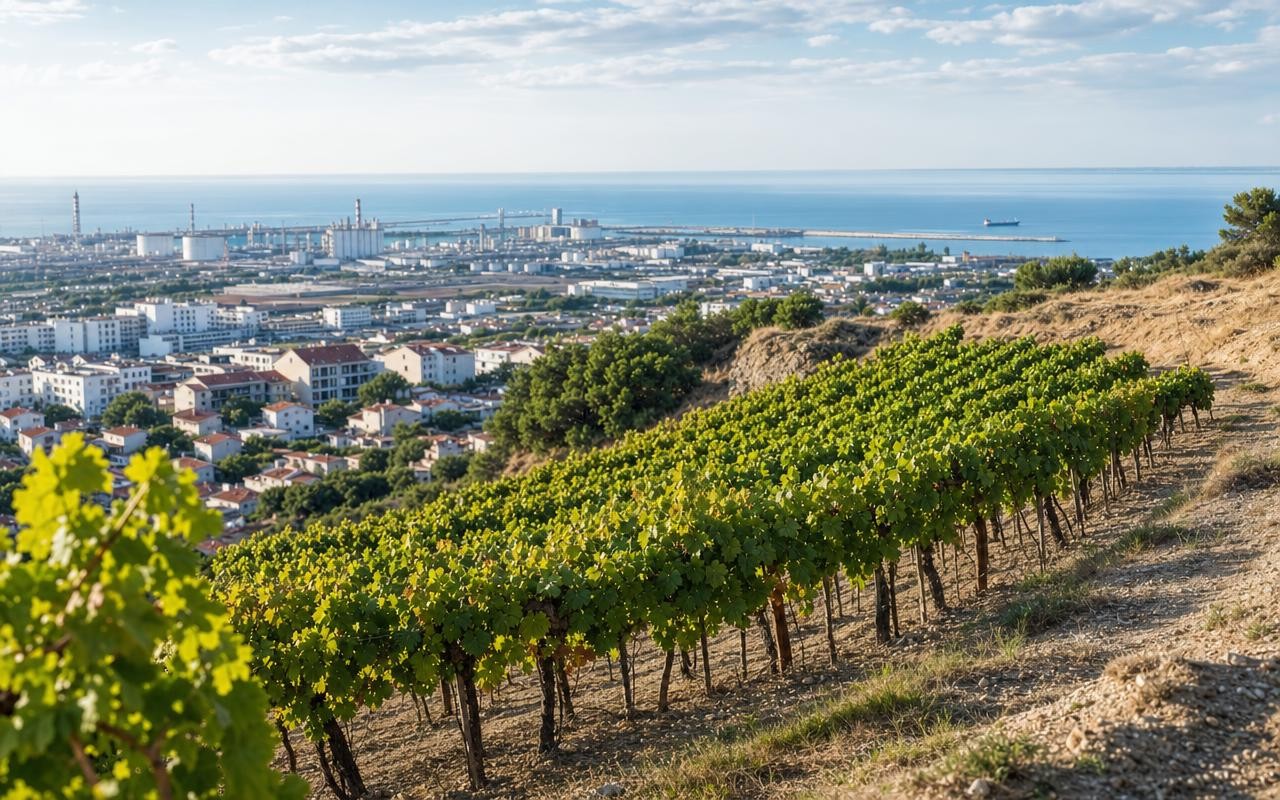
As we pass rows of vines on a Breton peninsula, at the foot of a slag heap or under the windows of Montmartre, we say to ourselves that the French wine list has changed a lot. Behind these unexpected plots, atypical vineyards in France are testing other ways of making wine.
In the vineyards, the situation has already changed: light clusters, wrinkled berries, harvest advanced in August and teams mobilized from dawn or night. For Jean-Luc Jamrozik, ” “, explains Jean-Luc Jamrozik, president of the sommeliers of Paris, quoted by France 3 Régions.
When the climate shakes up the atypical vineyards in France
According to Agreste, the statistical service of the Ministry of Agriculture, French wine production should fall below 34 million hectoliters in 2026, or around 4.5 billion bottles, down 6% compared to 2025 and 17% on the 2021-2025 average. 2026 promises to be the third consecutive small harvest after 2024 and 2025.
On the ground, ” “, notes Jean-Luc Jamrozik. Result: less juice in the tank, even if this juice remains ” “. To limit the damage, these are ” “.
Vineyards in Brittany, Normandy, Hauts-de-France: new atypical vineyards in France
Brittany is one of the surprises on this new map: around fifty vineyards have been established on the islands. On the Rhuys peninsula, in Morbihan, Marie Devigne and Guillaume Hagnier planted five hectares and their fourth Chardonnay harvest took place a month early due to the heat.
In Normandy, Axelle Piednöel has established a vineyard in Eure, banking on a future protected geographical indication. She says it: ” “, assures Axelle Piednöel to France 3 Régions. Same bet in Hauts-de-France, where rows of vines now line the slag heaps and where the association of regional winegrowers has become the 33rd federation of independent winegrowers.
Forgotten grape varieties and unusual know-how that inspire the wine of tomorrow
Faced with these constraints, winegrowers are focusing on forgotten grape varieties. In the 2000s, historic grape varieties such as Braucol or Prunelart were massively uprooted in favor of Cabernets and Merlots, but Mathieu Vieules, who has been working on the ancestral vines of Tarn for more than twenty years, assures: ” “, by cultivating Mauzac Rose, Jurançon Noir or Felen, grapes which are better resistant to heat waves and rot thanks to their thicker skin.
Working methods are also changing. In the Rhône valley, the slopes of Côte-Rôtie are so steep that Stéphane Ogier installed a monorail to harvest his Syrah grapes. In Saint-Jeannet, the Rasse family produces ” ” wine. In Paris, nearly 500 bottles of pinot noir are produced each year on the hill of Montmartre, while the Château de la Chaize is equipped with two robots to maintain its vines.
Why do we see vines in Brittany?
Milder climate and relaxed law.
What is an atypical vineyard in France?
A vineyard without historical bastions, rare grape varieties or unexpected methods.
Why do some winegrowers replant forgotten grape varieties?
They are more resistant to heat, disease and diversify tastes.
Sources
- Beauty Test
“This pillar of French aperitifs will be missing by 2026, what is happening at the moment in the vineyards is already panicking the producers”
