
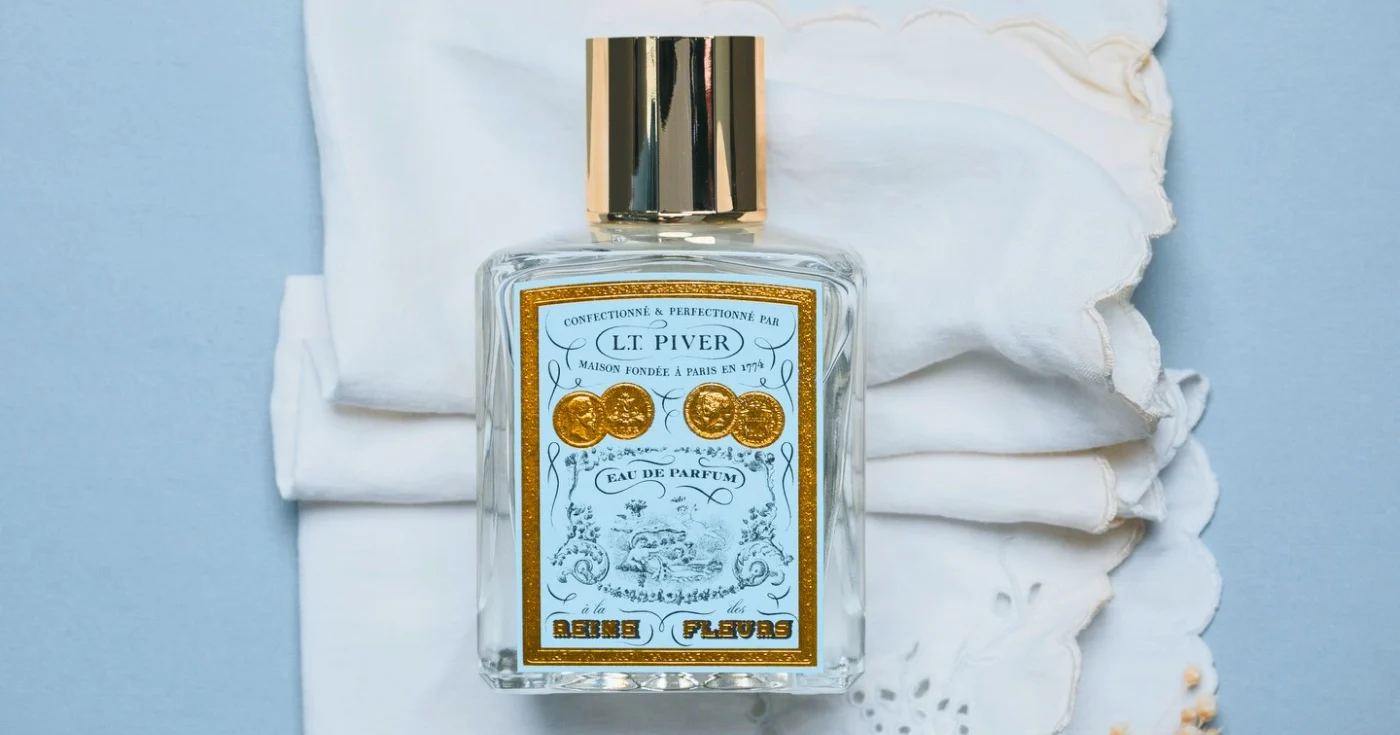
There are few objects capable of surviving two and a half centuries without losing their soul. One perfume, however, achieved it. “À la Reine des Fleurs” is not a marketing reissue or a nostalgic wink invented from scratch: it is a fragrance authentically born under the Ancien Régime, in a Parisian boutique frequented by the aristocracy, and which had the distinct honor of pleasing one of the most scrutinized women in French history, Marie-Antoinette.
What makes this story fascinating is not only its age, but its continuity: the house that created it still exists, the formula has survived the ages with only one major revision, and the bottle is today accessible to anyone who wants to wear, literally, a queen’s perfume. A look back at the history of a fragrance that has survived the Revolution, two centuries of fashion and all the passing trends in perfumery.
A Versailles boutique that has conquered Paris
The story begins in 1774, when Michel Adam, a perfumer-glovemaker originally from Versailles, opened a boutique in Paris that he decided to name “À la Reine des Fleurs”. The name is not insignificant: at a time when perfumery is a court art, associating your brand with a floral queen is a declaration of ambition as much as an early marketing move.
Success is immediate. Parisian customers flock to the store, but it is above all the interest of the court of King Louis XVI that will push the small house into another dimension. That same year, 1774, Michel Adam created his very first eau de Cologne, which he naturally named after his store: “Eau de Cologne de la Reine des Fleurs”. An aromatic and refreshing creation, thought of as a breath of pure air, far from the heavy and musky perfumes then in vogue in certain circles.
Marie-Antoinette’s favorite perfume
This is where the story takes an exceptional turn: Queen Marie-Antoinette herself adopted this eau de Cologne, which quickly became a must-have at the court of Versailles. For a fledgling perfume house, obtaining the favor of the sovereign is equivalent to absolute consecration. In a society where the customs of the court dictated the trends of the entire European aristocracy, the choice of Marie-Antoinette probably contributed to lastingly establishing the reputation of the house.
This proximity to royalty did not stop with the queen. According to the history of the house, the fragrance and its variations subsequently attracted other notable figures, from Prince Eugene to the Emperor of China, including the Army of the Rhine. A journey which illustrates to what extent this legacy has been able to cross borders and generations well beyond its circle of origin in Versailles.
A formula preserved since 1874
Unlike many “historic” perfumes which are vintage in name only, “À la Reine des Fleurs” has had a rather rare conservation trajectory. The original formula was revisited only once, in 1874, on the occasion of the house’s centenary. It is this version, developed more than 150 years ago, which is still offered today, without any other major modification.
This continuity is also explained by jealously guarded know-how: the manufacturing formula, developed by Louis-Toussaint Piver, is based on an artisanal technique called “maturation in drawers”. Each perfume, composed of more than 100 natural ingredients, matures slowly over three to four months, a process that allows the ingredients to harmonize in depth rather than simply being assembled.
Aromatic and refreshing notes
On an olfactory level, “À la Reine des Fleurs” is distinguished by an aromatic and lively signature, a thousand miles from the heady perfumes that we sometimes imagine associated with the 18th century. The head of the perfume opens with notes of verbena and orange blossom, immediately fresh and luminous. The heart then unfolds lavender, rosemary and thyme, an herbaceous signature that evokes sunny gardens. The base, more enveloping, is based on musk and ambrox.
The main ingredients, verbena, petitgrain and musk, are mostly sourced in Grasse and Italy, historic cradles of French perfumery, before being assembled and manufactured in France. The result is described as “the tender burning of herbs heated by the sun”, an evocation that immediately makes you want to go out for some fresh air, far from the powdery image that we often attribute to court perfumes.
A perfume still accessible today
What really sets “To the Queen of Flowers” apart from so many other historical accounts is that it is not an inaccessible museum piece. The perfume is still marketed by the LT Piver house, founded in 1774 and still in operation. It is offered in a 100 ml bottle, presented in a designer box designed to be reused once the perfume is finished.
Wearing this perfume today is therefore literally adopting the same fragrance as that which perfumed the wrists of Marie-Antoinette at Versailles, with the only nuance of the 1874 revision. A direct and tangible link with the history of French perfumery, at a time when many houses are content to evoke their heritage without ever making it concretely accessible.
FAQ – the perfume worn by Marie-Antoinette
What was Marie Antoinette’s favorite perfume?
Marie-Antoinette particularly appreciated the Eau de Cologne de la Reine des Fleurs, created in 1774 by the perfumer Michel Adam. This fragrance is at the origin of the perfume “À la Reine des Fleurs” still marketed today.
Does Marie-Antoinette’s perfume still exist?
Yes. The LT Piver house continues to produce this perfume, the formula of which was revisited only once, in 1874, then preserved until today.
What are the olfactory notes of À la Reine des Fleurs?
The fragrance opens with verbena and orange blossom, reveals a heart of lavender, rosemary and thyme, then ends with notes of musk and ambrox.
Where are LT Piver perfumes made?
The perfumes are made in France, in Chartres, from ingredients mainly sourced in Grasse and Italy, using a maturation technique in drawers for three to four months.
How long has LT Piver been around?
The house was founded in 1774 in Paris.
