
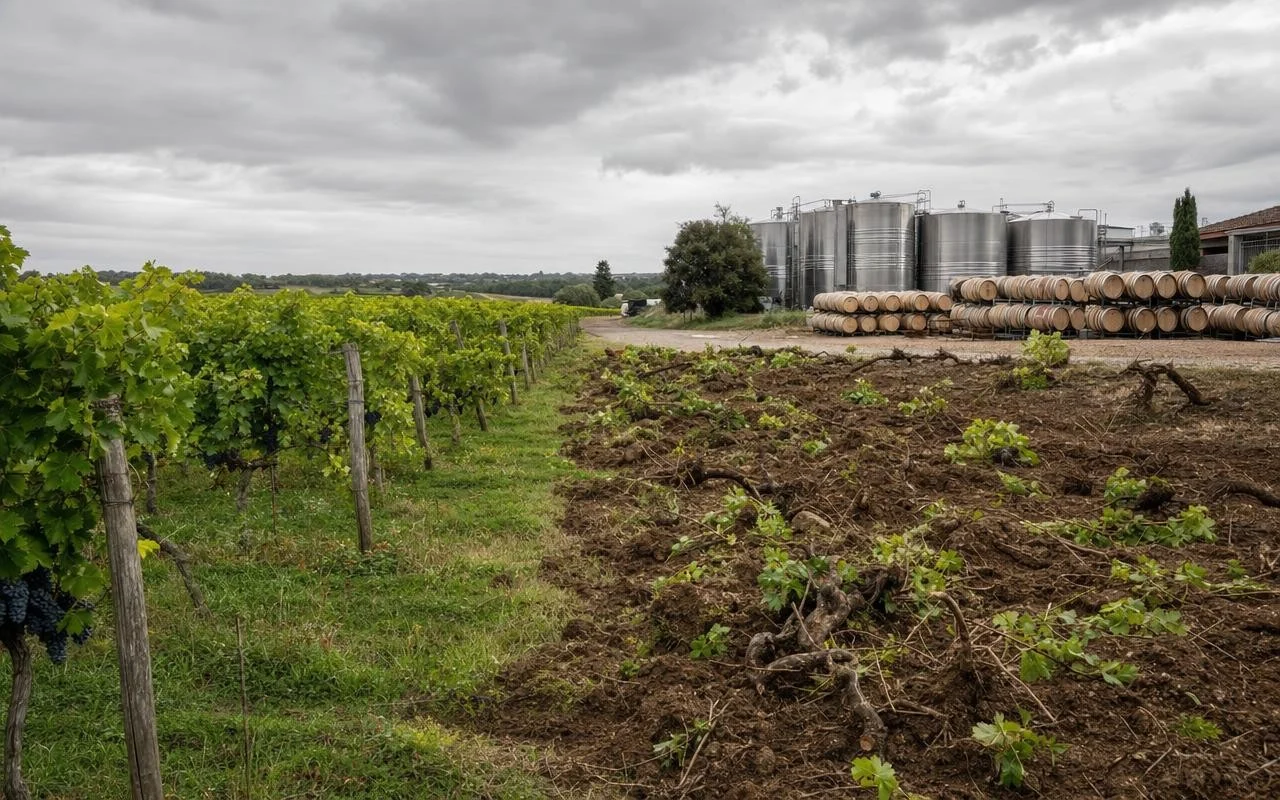
The leading wine exporting country in terms of value, France is nevertheless uprooting vines and triggering emergency plans. The French wine industry, a symbol of national identity, is going through a polycrisis of falling consumption, unstable climate and increased competition. The figures remain XXL, but stocks are swelling and certain vineyards can no longer find buyers for their vats. But the story is more fragile than it seems.
In 2024, the Ministry of Agriculture identified 17 wine regions, nearly 200 grape varieties and some 53,000 farms which cultivate 773,000 hectares of vines, or around 3% of the French agricultural area. However, these vines represent around 11% of the world’s surface area of wine vines and produce 4.9 billion bottles per year, or 3.65 billion liters. This represents more than 15% of global wine production. The entire sector, from vines to glass, generates 92 billion euros in turnover, or around 1.4% of French GDP.
A French wine industry of excellence, light in surface area but heavy in value
Within the agricultural economy, viticulture occupies a special place. In 2021, 58,310 wine farms represented 15% of the 387,290 French agricultural farms, for an area of 782,214 hectares of UAA in 2023, including 745,000 hectares actually in production, or only 3% of the total UAA. 73% of these farms are less than 20 hectares, but the value created by these small areas remains considerable. Languedoc-Roussillon remains the largest vineyard, with more than 185,000 hectares, ahead of Bordeaux and its 119,000 hectares, while Burgundy, Beaujolais, Savoie and Jura combined reach 50,000 hectares.
In 2023, 56% of French vineyards are devoted to AOP wine, 27% to IGP and 5% to wines without geographical indication, for a total production of 33.5 million hectoliters of wine. The AOP generate more than 19 million hectoliters, the IGP nearly 12 million and the other categories 2.5 million, volumes very dependent on the climate: production had climbed to 37.8 million hectoliters in 2018, before falling below 28 million in 2021. France, long the country of red, experienced a historic shift with the rise of white.
- 12.8 million hectoliters of red wines
- 13.4 million hectoliters of white wines
- 6.9 million hectoliters of rosé wines
Leading world exporter of wine in value, driving force of French trade
The value of French wine production will reach 15.5 billion euros in 2023, while vines cover only 3% of agricultural land. Wine exports show a positive balance of around 11 billion euros, and the wine and spirits duo carries the agri-food surplus with an overall surplus of 14.73 billion. France remains third exporter in volume but first in value, with an average price of 9.08 euros per liter, while Italy is limited to 3.74 euros and Spain to 1.52 euros. It represents almost a third of the global wine export market, its top five customers being the United States, the United Kingdom, China, Germany and Singapore, with the United States accounting for 24.5% of foreign sales in 2024.
In this value-oriented model, a few names pull the locomotive. In 2024, wine exports will reach 10.9 billion euros, including 3.8 billion for champagne and 1.6 billion for Burgundy: these two vineyards account for 49.6% of the value of exports for only 15.6% of volumes. On the spirits side, cognac still represents 3 billion euros and nearly 67% of the exported value, despite a recent decline. And then a new generation of French whiskeys, up 21% in 2024, is beginning to find its place on international markets.
Falling consumption, climate, organic: a French wine industry under pressure
On the domestic market, the change is brutal. In 1975, each French person drank on average 100 liters of wine per year, compared to 40 liters today, which greatly reduces the outlets for everyday wines. Production reached historically low levels in 2025, with a drop of around 10% in cultivated areas in ten years and demands for grubbing up of up to 35,000 hectares in the most fragile basins. Bordeaux, Languedoc and the south of the Rhône valley are seeing plots disappear due to lack of profitability.
At the same time, the environmental transition is progressing quickly and reshaping the landscape. Already 23% of wine-growing areas, or more than 170,000 hectares, are managed organically in 2023, making France the leading organic vineyard in the world, and 62% of farms are certified high environmental value. , notes a 2024 publication from INSEE. To support this shift while managing the crisis, the State has already committed more than a billion euros in exceptional aid since 2020, while FranceAgriMer recalls that the strategy of moving upmarket makes the sector more exposed, observes FranceAgriMer.
How is the French wine industry characterized today?
It is based on approximately 773,000 hectares of vines, 17 wine-growing regions and some 53,000 farms. Despite only 3% of the agricultural area used, it generates 4.9 billion bottles per year and 92 billion euros in turnover.
Why is France the world’s leading exporter of wine by value?
The French model favors moving upmarket, with an average export price of around 9.08 euros per liter, much higher than its Italian and Spanish neighbors. Champagne, Burgundy and cognac concentrate a large part of this value internationally.
What are the main challenges for the French wine industry?
The lasting decline in wine consumption, climatic volatility of harvests and international competition are putting pressure on vineyards, especially mid-range ones. The sector must at the same time finance its environmental transition, between organic development and demanding certifications.
