
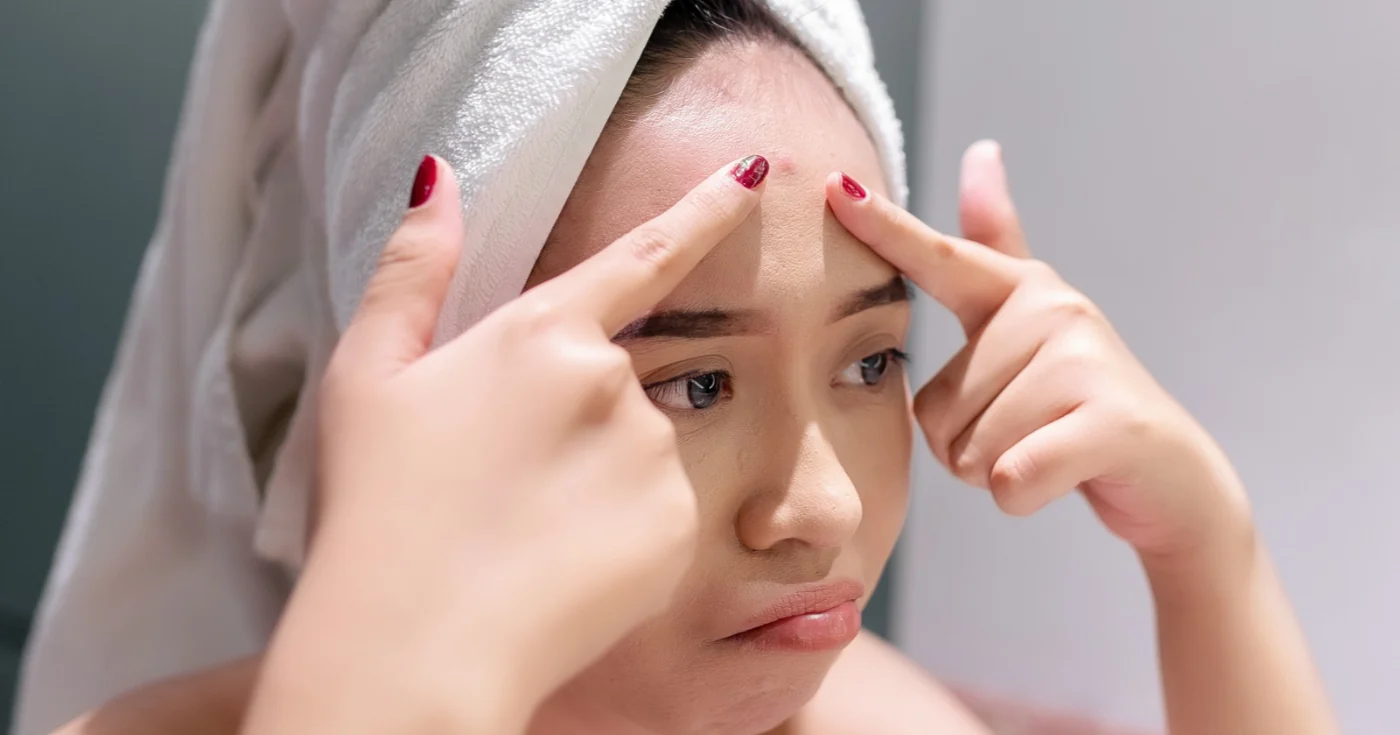
No matter how much you clean your face morning and evening, apply an anti-blemish serum and use more exfoliants, these little pimples on your forehead don’t disappear. They are sometimes so discreet that you notice them mainly by passing your hand over your skin or looking closely at yourself in the mirror. What if the problem didn’t come from your anti-acne routine?
Because not all small irregularities on the forehead are necessarily acne spots. Some may be related to hair products, clogged pores, or an inflammatory condition of hair follicles called hair folliculitis. The latter is sometimes nicknamed “fungal acne”, even if it is not a form of acne strictly speaking. Here’s how to better understand what’s happening to your skin.
These small, uniform pimples could be Malassezia folliculitis
This is a trail to be aware of when the buttons are numerous, very small and surprisingly similar to each other. Folliculitis is an inflammation of the hair follicles associated with the proliferation of yeasts of the genus . These microorganisms are naturally present on the skin, but can, under certain conditions, multiply in the follicles and cause a rash. The phenomenon is sometimes called “fungal acne” or “fungal acne” on social media. However, it is not classic acne.
According to the medical site DermNet, this folliculitis can manifest itself in particular by small papules or pustules quite similar in appearance, which often itch. It frequently affects the upper back and thorax, but can also appear on the face, particularly the forehead and hairline. Another interesting clue: unlike acne vulgaris, it generally does not present comedones, that is to say blackheads or whiteheads. The fact sheet dedicated to Malassezia folliculitis by DermNet details these characteristics.
Your hair products may also be responsible
Another explanation, more banal but often overlooked: the products you apply to your hair. Oils, masks, conditioners, leave-in treatments or styling products can come into contact with the forehead, especially at the hairline. Certain oily or occlusive ingredients may cause pores to become clogged and small imperfections to appear.
The American Academy of Dermatology (AAD) describes this phenomenon as “acne cosmetica” when related to cosmetic products. Pimples can be particularly inconspicuous, concentrated on the top of the forehead, and sometimes felt more to the touch than seen. The organization recommends in particular to check the products used, to favor those marked “non-comedogenic” and to ensure that hair care products are rinsed thoroughly. You can find his advice in his article Are your hair care products causing breakouts?.
What if it was just comedonal acne?
Be careful, small skin-colored pimples on the forehead could very well be acne. There is in particular a so-called comedonal form, characterized by the presence of closed comedones: small whitish or skin-colored bumps, which sometimes give an irregular appearance to the surface of the face. They correspond to blocked follicles and are not necessarily red or painful.
DermNet points out that these closed comedones are common on the forehead and chin. Unlike folliculitis, they can coexist with blackheads and other acne lesions. This is why the appearance of the spots, their distribution and any itching are useful clues, but are not always enough to make a diagnosis. The DermNet fact sheet on comedonal acne allows you to better understand this form of acne.
How to react without making imperfections worse?
First reflex: avoid multiplying exfoliating active ingredients or anti-acne treatments without knowing what you are dealing with. If the spots are linked to folliculitis, a routine designed exclusively for classic acne may not solve the problem. Conversely, using an antifungal treatment on your own is not a good idea: the presence of small, uniform pimples is not enough to confirm folliculitis.
You can start by observing recent changes to your routine: new hair care, oil applied near the roots, particularly rich cream or styling product that touches the forehead. Favor gentle cleansing, rinse your hair thoroughly and avoid products that seem to encourage breakouts. If the spots persist, itch, spread or resist usual care, make an appointment with a dermatologist. He will be able to examine the lesions and, if necessary, take a sample to confirm or rule out folliculitis. The Cleveland Clinic points out that the diagnosis can be based in particular on the examination of the skin and the analysis of a sample.
FAQ: the questions you ask yourself about small pimples on the forehead
1. How do I know if my little pimples on my forehead are acne or folliculitis?
Acne can present with different lesions, including blackheads, whiteheads and inflammatory pimples. Folliculitis manifests itself more readily as small lesions that are very similar to each other, often accompanied by itching and without blackheads. However, only a healthcare professional can confirm the cause.
2. Is Malassezia folliculitis contagious?
No, it is generally not considered contagious. Yeasts of this genus are naturally part of the microorganisms present on the skin. It is their proliferation in the hair follicles that can cause inflammation.
3. Why do these pimples appear mostly on the forehead?
The forehead is close to the hairline and can be exposed to sebum, perspiration and hair product residue. It is also one of the areas of the face where certain forms of folliculitis can appear.
4. Can we use anti-acne treatments on Malassezia folliculitis?
Conventional anti-acne treatments do not necessarily target the cause of this folliculitis. Antifungal treatment may be indicated, but it must be chosen with a healthcare professional after confirmation of the diagnosis.
5. When should you consult a dermatologist for pimples on the forehead?
If the imperfections persist despite a gentle routine, are accompanied by itching, become inflammatory or spread, it is better to seek medical advice. A consultation is also useful when you are unable to identify their origin.
