
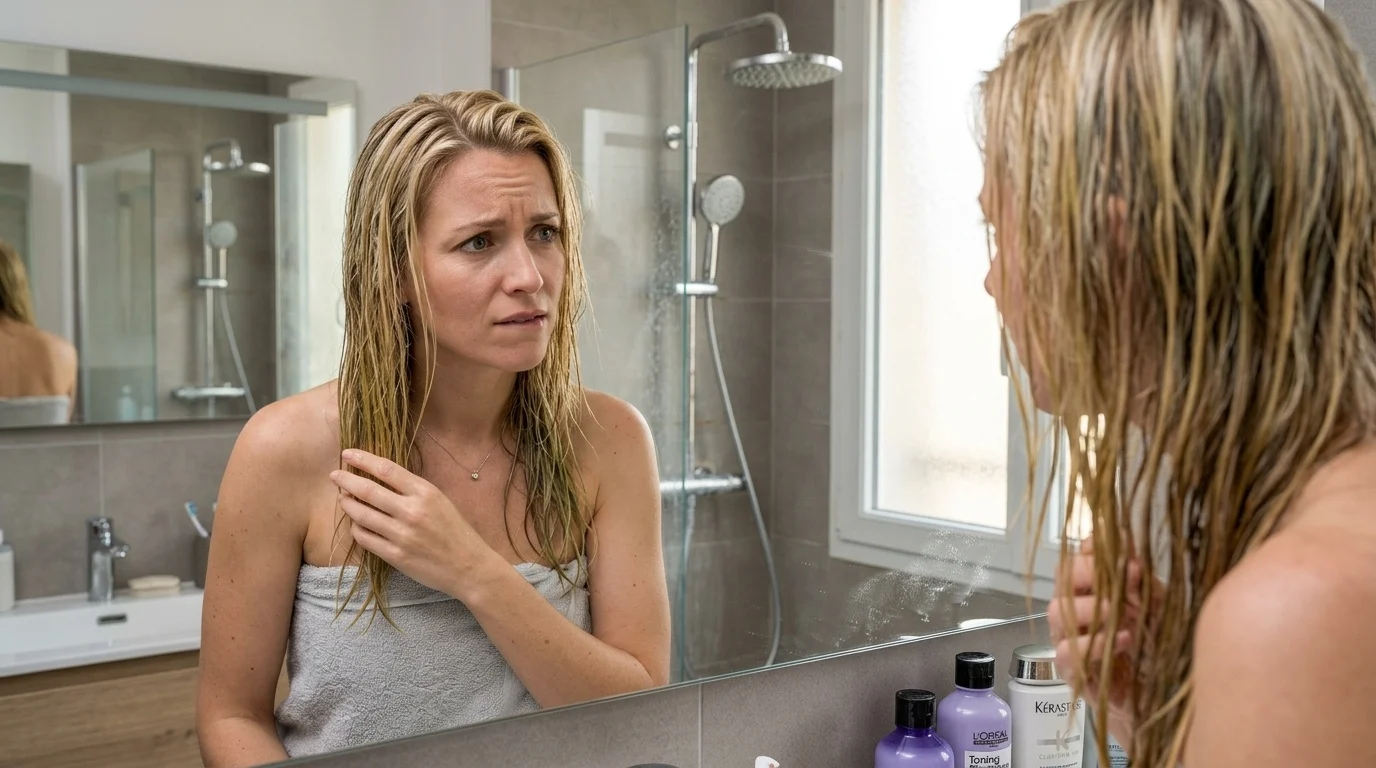
The cold blonde weathered two weeks ago that suddenly transforms into straw yellow, the delicious brown that tends towards red, or worse, those green reflections that appear on bleached locks: many know this thrill in front of the mirror. We blame the coloring, the sun, the shampoo. We almost always forget what comes out of the shower every day. And there, the surprise is rarely good.
Because basically, if your coloring that turns yellow or green seems “inexplicable” to you, the culprit is not necessarily the hairdresser. Interviewed by the magazine, colorist Tracey Cunningham reminds us that you must protect your colored hair as you protect your skin, and that the first enemy to watch out for is tap water. Everything often happens in the shower, with each wash.
Coloration that turns yellow or green: when the shower water disrupts everything
What professionals describe is simple: hair does not change color on its own overnight, it is almost always a sign of mineral accumulation in the hair fiber. In a large part of France, water is called “hard”, loaded with calcium and magnesium. These minerals form a limescale film which is deposited on the hair, making it darken, thickening it and can even alter the texture.
The iron contained in water creates coppery or orange highlights on dark browns and blondes. As for copper, by oxidizing over time, it easily gives that famous greenish tint that all blondes fear, even without spending the summer in a swimming pool. The more the hair has been bleached or highlighted, the more porous it is, therefore the more it captures these minerals with each shampoo.
Hard water, minerals and colored hair: the repeated mistake in the shower
The mistake that many people make without thinking about it is to systematically rinse colored hair with hard, unfiltered water, often very hot, as if this water were neutral. Hot water further opens the cuticles, already weakened by coloring, which lets minerals in and pigments out. Through washing, cold tones erode, deposits accumulate and yellow, red or green reflections end up dominating.
We then blame the shampoo or the “bad” coloring, when the problem mainly comes from this repeated routine in the shower. The signs speak for themselves: color that changes in two or three weeks instead of lasting a month and a half, blondes that turn yellow very quickly between two patinas, browns that turn red, lengths that are heavy and dull despite care. When the roots remain fresh but the ends change tone, mineralized water is often the culprit.
How to prevent color from turning yellow or green in the shower
For Tracey Cunningham, the most straightforward solution is to install a filter on the shower head to reduce the concentration of minerals before they even reach the hair. This gesture is particularly useful in areas where the water is very hard, and many large French cities are concerned. The investment remains modest compared to coloring that has to be redone prematurely, and really changes the situation in terms of the staying power of highlights.
And then there are all the little reflexes to adopt on a daily basis. Use lukewarm water rather than hot water for washing and rinsing, choose a gentle shampoo that does not strip pigments, limit washing to a few times a week. A targeted “hard water” detox or clarifying treatment once or twice a month helps remove accumulated minerals. Then, purple shampoos or masks to neutralize the yellow, blue to calm the coppery reflections, help rebalance the color. In case of marked green reflections, it is better to combine an anti-mineral treatment and a patina in the salon, making it clear to the colorist that the water in the house is very hard.
Why does my color turn yellow or green even though I use a good shampoo?
If your shower water is limestone or rich in metals such as iron and copper, these minerals accumulate on the fiber, making cold tones disappear and leaving yellow, orange or greenish reflections, especially on bleached hair.
Is a shower filter enough to protect my colored hair from hard water?
A shower filter significantly reduces the amount of minerals deposited on the hair, which helps the color stay stable longer. For optimal results, combine with lukewarm water, a gentle shampoo and occasional detox treatments.
How to fix blonde hair that has turned green in the shower?
Start with a detox or clarifying treatment designed to remove minerals, then use a repigmenting treatment or a patina adapted to neutralize the green. If the color is very strong or the hair has been bleached a lot, a visit to the colorist is strongly recommended.
