
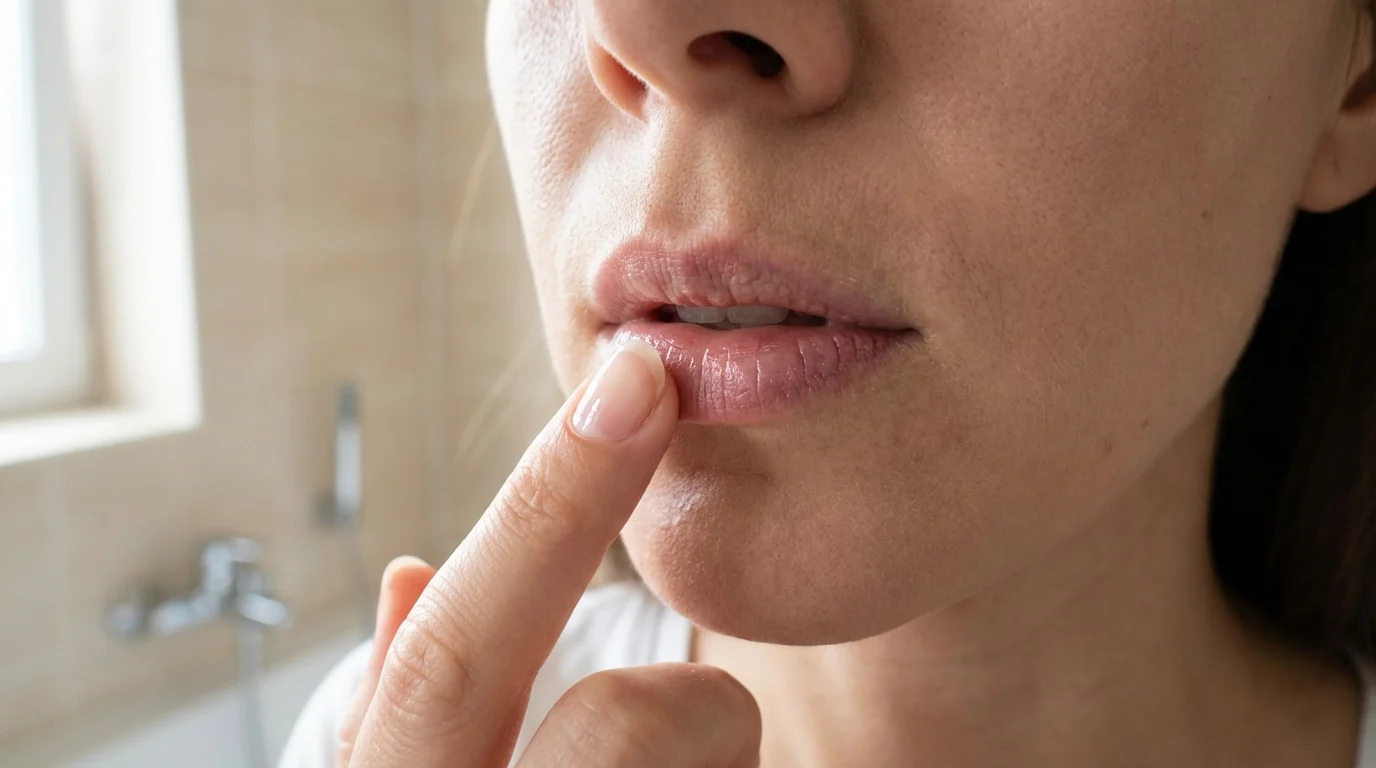
Red lips that burn, little skin that cracks as soon as you smile, lipstick that marks every crack… When eczema on the lips sets in, it’s impossible to ignore it, let alone forget it during a dinner or a meeting. However, this area often remains the most forgotten in skincare routines, even though it reacts very quickly to the slightest irritant. And certain gestures that we repeat mechanically all day can maintain it in silence.
Snacking, chewing gum, long-lasting makeup, reflex to lick your lips… A dermatologist, Dr. Andrea Suarez, widely followed on TikTok, detailed several habits that promote these red patches around the mouth, comments relayed by Femme Actuelle. Advice supplemented by recommendations from Célia Guévara, specialist in eczematous skin, to adapt your makeup products. Together, they shed light on what is really happening on this ultra-fragile skin.
Eczema on the lips: a fragile area that is quickly irritated
The skin of the lips is much thinner than that of the rest of the face and does not have sebaceous glands, therefore almost no natural oily film. Anything dries it out: cold, wind, friction, repeated contact with acidic foods. For Dr Andrea Suarez, when red patches, itching and cracking multiply, explains the dermatologist in her TikTok video relayed by Femme Actuelle. She also recalls that.
And here, we understand better why tics around the mouth matter so much. Dr. Suarez details that saliva. Result: the lips dry out even more, crack, crusts can appear on the corners, the famous perlèche. When, she specifies.
Bad daily habits that cause lip eczema
First reflex to point out: lick your lips constantly to “relieve” them. This gesture continuously exposes them to this irritating saliva described by the dermatologist. Same problem with people who fall asleep with their mouth half open or on their side, leaving saliva to stagnate all night in the corners. Another underestimated habit, intensive chewing of flavored chewing gum: explains Dr Andrea Suarez.
Certain foods can also cause lip eczema to flare up, particularly juicy fruits like mango or papaya, whose juice easily overflows around the mouth. The dermatologist then advises: . Once these tics are identified, other reflexes can maintain the inflammation:
- scratch lesions or tear off small dry skin on the lips;
- frequently wearing varnished hands or nails in the mouth;
- go out in cold or windy weather without very oily protective balm.
Care, makeup and reflexes to calm mouth eczema
To break this vicious circle, Dr. Suarez first insists on stopping licking the lips and systematically rinsing the area around the mouth after juicy fruits. In terms of protection, she recommends the original Vaseline which, according to her, . For those who prefer to avoid this petroleum-derived ingredient, alternatives such as shea butter or very fatty sticks, without perfume and with few preservatives, also help to restore the skin barrier. In the event of frequent or very bothersome breakouts, a doctor or dermatologist can offer specific local treatment.
When you love makeup, adapting your products changes a lot of things. Célia Guévara reminds us that, she explains in Marie Claire. On the mouth, this means avoiding matte or long-wearing lipsticks that are drying, systematically moisturizing the lips before coloring and, as she sums it up, . Satin or very moisturizing formulas, combined with gentle finger makeup removal with high-tolerance products, limit irritation.
Eczema on the lips: is it contagious?
No, mouth eczema is not an infection and is not spread from person to person. It is an inflammatory disease linked to an atopic site or to contact reactions.
Which balm to choose for lip eczema?
Dermatologists recommend very fatty sticks, without perfume and with few preservatives, or simple fatty substances such as petroleum jelly or shea butter. The goal is to protect and nourish without adding allergens.
Can you wear lipstick when you have eczema on your mouth?
Yes, apart from the most inflammatory outbreaks, with moisturizing or satin lipsticks and not matte ones. It remains important to moisturize beforehand and gently remove makeup from the mouth.
When to consult a dermatologist for lip eczema?
A consultation is necessary if the plaques come back often, expand, become painful or ooze. Specialist advice is also useful in the event of a suspected allergy to a cosmetic or toothpaste.
