
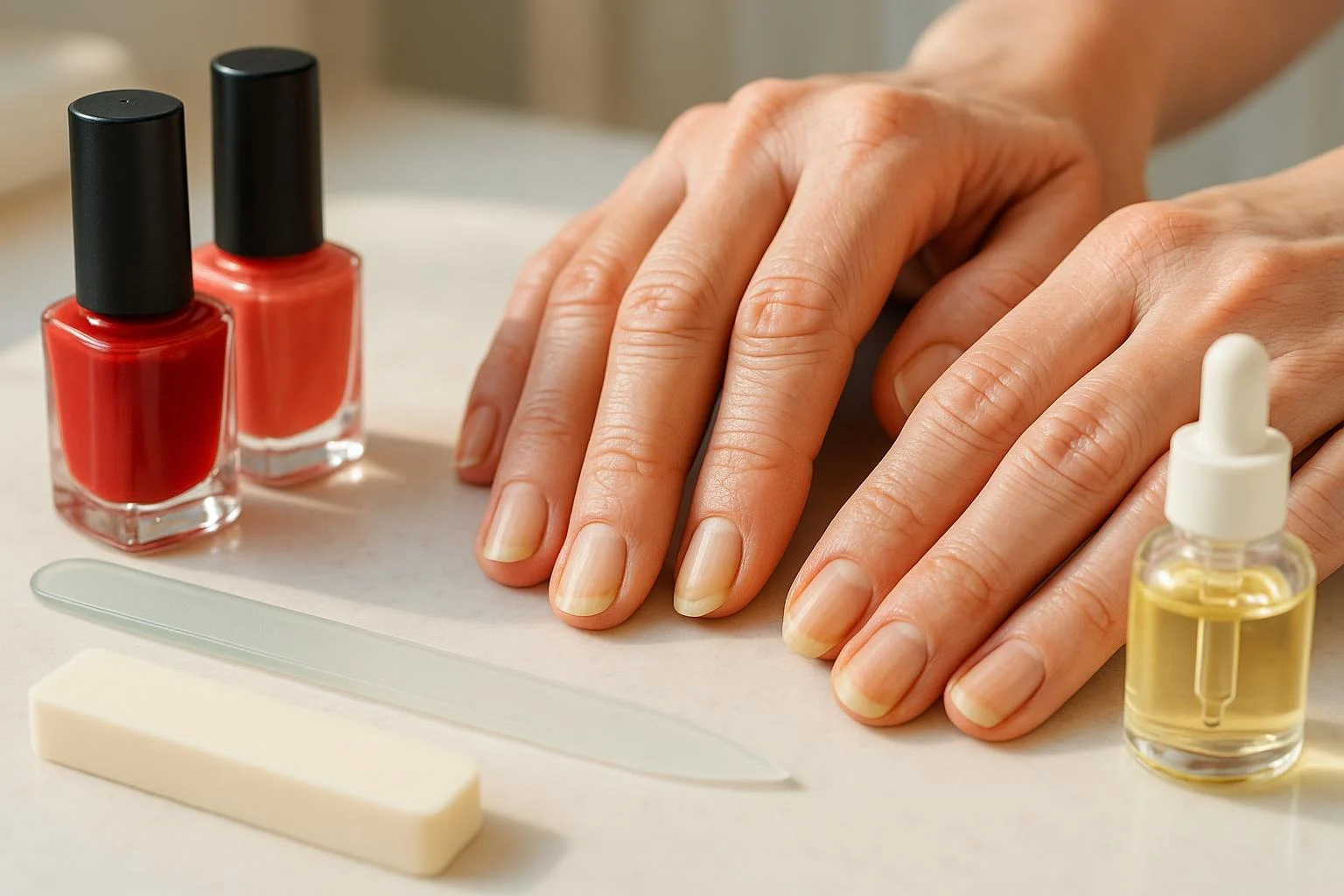
Between manicure, science fiction-style chrome nails and ultra-pigmented burgundy varnish, our hands have never been so worked. But once the varnish is removed, the observation is sometimes less glamorous: yellow nails, white spots, free edge that splits, plaque that becomes thinner. A detail that we often hide under a new layer of color, without really wondering what is really going on underneath.
Because between preconceived ideas and gestures learned on TikTok, certain habits that we repeat without thinking can weaken the nail, color it, or even mask a real health problem. Nails yellowed by pigments, streaks accentuated by polishing, damaged cuticles… What if we looked a little closer at what, in our routine, really damages them?
Yellow nails: what your manicures are really hiding
When the nails turn yellow after several coral, ruby or burgundy manicures, it is most often a coloring due to the red pigments in the varnishes. This shade is especially visible in summer: UV rays pass through the varnish and literally “print” the nail. Even some beige shades can stain plaque because of the nitrocellulose in the formula. The right reflex is simple but non-negotiable: always apply a protective base before varnishing, even if this is not always enough to completely prevent yellowing.
And then there’s everything that has nothing to do with the color applied. Tobacco can cause nails to turn yellow over time, as can a fungal infection – onychomycosis – which is often accompanied by thickening and sometimes an unpleasant odor. Other more internal causes also exist: nail psoriasis, iron or zinc deficiency, liver problems linked to bilirubin, or even yellow nail syndrome. When several nails turn yellow without varnish or special manicure, or change thickness and shape, it is better to talk to a doctor or dermatologist rather than settling for a new top coat.
Bad habits that damage nails (and turn them yellow)
Good news first: the semi-permanent varnish sold today in the European Union no longer contains TPO, diphenyl trimethylbenzoyl phosphine oxide, classified as a CMR substance and now banned. Brands have anticipated the legislation by replacing it with other photo-initiators such as TPO-L, TMO or BAPO, to offer formulas. The problem comes elsewhere: chaining applications without letting the nail breathe, systematically zapping the base, or tearing off your semi-permanent as soon as it flakes. At home, we do not sand the natural nail: we very lightly file the varnished surface, we soak cotton pads in acetone nail polish remover, we place them in aluminum foils or in silicone tips, we wait 10 to 20 minutes then we gently remove the material with a quick remover type tool, without scratching.
Another reflex that is damaging in the long term: wanting to “perfect” everything. Polishing every week ends up thinning and weakening the nail. The right pace is once or twice a month maximum with a classic polisher, forgetting the multifunction electric models, which are too aggressive. Same vigilance around the edge of the nail: we often confuse cuticles – these little dry skins that can be peeled off with an emollient gel and a boxwood stick – and the proximal ridge, this living skin which protects the matrix. Cutting it opens the door to bacteria and thickens the area over time. Added to this are metal files, which risk splitting or splitting the nail, much more than glass or cardboard. The famous white spots are most often the trace of micro-trauma to the womb, while the blue or purplish spots on the toes betray shoes that are too tight or nails that are too long.
The right actions to treat yellow and weakened nails
To correct nails yellowed by colored varnishes, the priority remains to take a real break. We remove everything, we leave the plate bare for several days, even several weeks, and we rely on basic care: nourishing oils and balms applied to the nail and the proximal area to soften them. You can use a non-abrasive chamois leather polisher to restore a little shine without eating away at the material, and a smoothing base which fills in the streaks and visually blurs the color while waiting for regrowth. Over the weeks, the yellowed part advances and ends up being cut off.
Because ultimately, keeping your nails clean, smooth and stain-free requires, above all, changing the rhythm. Space out highly pigmented manicures – frosted raspberry, burgundy, coral red – alternating with periods without varnish, apply a base before each color, avoid polishing too often, prefer glass or cardboard files, file in one direction only, cut your toenails well and choose suitable shoes. And if despite these efforts the yellowing persists, is accompanied by thickening, detachment or pain, consult a health professional, because certain conditions such as onychomycosis, nail psoriasis, a liver disorder or yellow nail syndrome require medical advice. On the networks, comments are often ecstatic saying that, comment certain Internet users, quoted by the media Ma-grande-taille. Behind the scenes, a regular care routine allows you to enjoy these futuristic manicures without making your nails pay the bill.
FAQ – Yellow nails and damaged nails: your questions
Why do my nails turn yellow after polish?
Coral, ruby, burgundy or certain beige varnishes contain pigments – and sometimes nitrocellulose – which can color the plate, especially if they are worn for a long time, often, and without a protective base. UV rays reinforce this effect by passing through the varnish and “staining” the nail.
How to remove yellow from nails?
Remove all varnish, let the nail rest, then nourish regularly with oils and balms. Very gentle polishing once or twice a month maximum can help, as well as a smoothing base which visually blurs the coloring, while the nail grows back and the yellowed part is cut off.
Does semi-permanent varnish damage nails?
Current formulas no longer contain TPO, a CMR substance banned in the European Union, and use other photo-initiators such as TPO-L, TMO or BAPO. What mainly damages the nail are applications that are too close together, the absence of breaks, and aggressive applications where the material is sanded or torn off instead of gently dissolving it with acetone.
When should you see a doctor for yellow nails?
If your nails turn yellow even though you wear little or no nail polish, if several fingernails and toenails change appearance, thicken, peel off, become painful or give off an odor, it is important to consult a doctor or dermatologist. Certain pathologies, such as mycosis, nail psoriasis, liver problems or yellow nail syndrome, require an appropriate diagnosis and treatment.
